
When you’re looking to become a Professional Engineer in the United States, understanding the path to licensure can help you plan your next steps. Whether you’re gaining engineering experience or starting to prepare for the licensing exam, you may be asking: What is the PE exam, and how should I prepare?
The PE exam, short for Principles and Practice of Engineering, is the NCEES licensing exam that engineers take after gaining work experience to earn the Professional Engineer (PE) license.
The Civil PE has 80 questions, is computer-based and is offered year-round. About 65% of first-time Civil PE takers passed in the January to June 2026 window (NCEES data, weighted across the five Civil exams).
Plan for roughly 100 to 250 study hours, depending on your background, and spend them on three things: knowing your references, practicing under time pressure, and using questions you can trust. Once you pass, you keep the license by renewing on time and, in most states, completing continuing education hours (PDHs).
Every exam cycle, engineers ask us the same questions:
- What exactly is on this exam?
- How hard is it really?
- What changes if I am licensing in California?
- How should I spend my study time?
- How do I keep my license once I have it?
This short guide answers these questions with current numbers from NCEES and from the California Board for Professional Engineers, Land Surveyors, and Geologists (BPELSG), followed by practical preparation advice and a state-by-state look at keeping your license active.
The data in this blog was last checked in November 2026. NCEES refreshes its pass rates every January and July, so we revisit this post after each release.
What Is the PE Exam?
PE stands for Principles and Practice of Engineering. NCEES, the National Council of Examiners for Engineering and Surveying, writes and scores the exam, while each state licensing board decides who may sit for it and who receives a license. NCEES describes the PE as a test of minimum competency in a particular discipline, designed for engineers with at least four years of post-college work experience.
The exam matters because the license is what lets you sign and seal engineering work offered to the public, supervise other engineers, and, in many states, practice independently. The exam is the gate; the license is what you are really after.
What is the Path to Becoming a Professional Engineer?
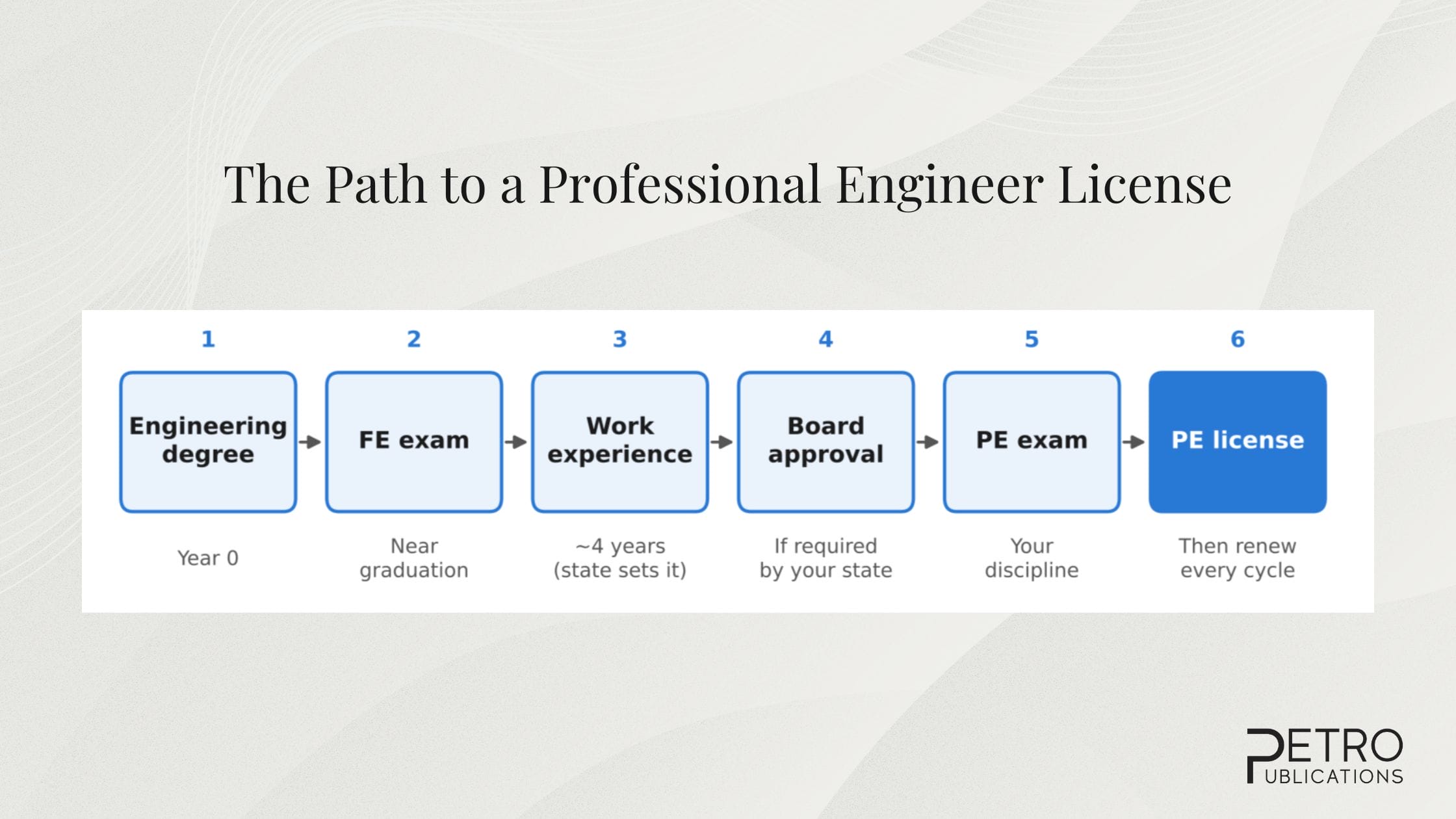
- Earn an engineering degree. Most boards expect an ABET-accredited program, and many offer alternate routes.
- Pass the FE exam, usually close to graduation. You may take it long pass your graduation as well!
- Gain qualifying experience under licensed engineers and document it. NCEES designs the PE for engineers with at least four years; your board sets the exact requirement.
- Get board approval if your state requires it, then register through your MyNCEES account and book a seat at a Pearson VUE test center.
- Pass the PE exam in your discipline.
- Apply for the license. In California, this step includes two additional state exams, covered below.
The order of these steps varies by state. Some boards approve your application before the exam, others after it, so check your board’s rules before you register. Learn more about Civil PE work experience requirements and how experience is typically evaluated.
Why Is the PE License So Important?
The PE license is the one credential that carries legal weight in engineering. In most states only a licensed Professional Engineer can sign and seal plans, calculations, and reports for work offered to the public, which is why the license sits behind so many career milestones. Public agencies and many clients require a PE of record on their projects. Firms need licensed engineers to take responsibility for their designs. And you generally cannot lead a firm, offer engineering services directly to the public, or serve as an expert witness without one.
The license also reflects a duty. A licensed engineer is personally accountable for the safety of the people who use what they design, and the board can discipline or revoke the license if that duty is not met. That accountability is the reason licensing exists, and it is also why you must keep the license active after you earn it (see How do you maintain your PE license? below).
What Does the Civil PE Exam Look Like in 2026?
Under the April 2024 specifications (later updated to the 2027 specifications), each Civil PE exam is a single 80-question exam in one discipline: Construction, Geotechnical, Structural, Transportation, or Water Resources and Environmental. Here is the format at a glance.
| Item | Civil PE exam (NCEES) |
|---|---|
| Questions | 80, all required |
| Appointment time | 9 hours: 2-minute NDA, 8-minute tutorial, 8-hour exam, 50-minute scheduled break |
| Delivery | Computer-based at NCEES-approved Pearson VUE test centers, year-round |
| Question types | Multiple choice and alternative item types (AITs) |
| References | NCEES PE Civil Reference Handbook plus the design standards listed in your exam specification, as searchable PDFs. No personal copies. |
| Fee | $400 paid to NCEES. Your board may charge a separate application fee. |
| Results | Pass or fail, typically within 7 to 10 days. A diagnostic report if you do not pass. |
| Retakes | One attempt per testing window and no more than three in 12 months (NCEES policy). Your board may add its own rules. |
Source: NCEES Civil PE exam page.
Do the math before you study. The exam portion is 8 hours for 80 questions, which averages 6 minutes per question, and that average includes the time you spend finding information. This is why reference navigation matters as much as calculation skill.
“Open book” means something different now. On the computer-based exam you cannot bring your own books. NCEES supplies the handbook and the listed standards as searchable PDFs inside the exam software, so what you are tested on, in practice, is how quickly you can locate and apply the right information.
How big are the reference sets? They are large. Under the current specifications, the reference sets run from thousands of pages per discipline and that list grows in 2027 – see our blog on updated specifications.
What Are the PE Exam Pass Rates?
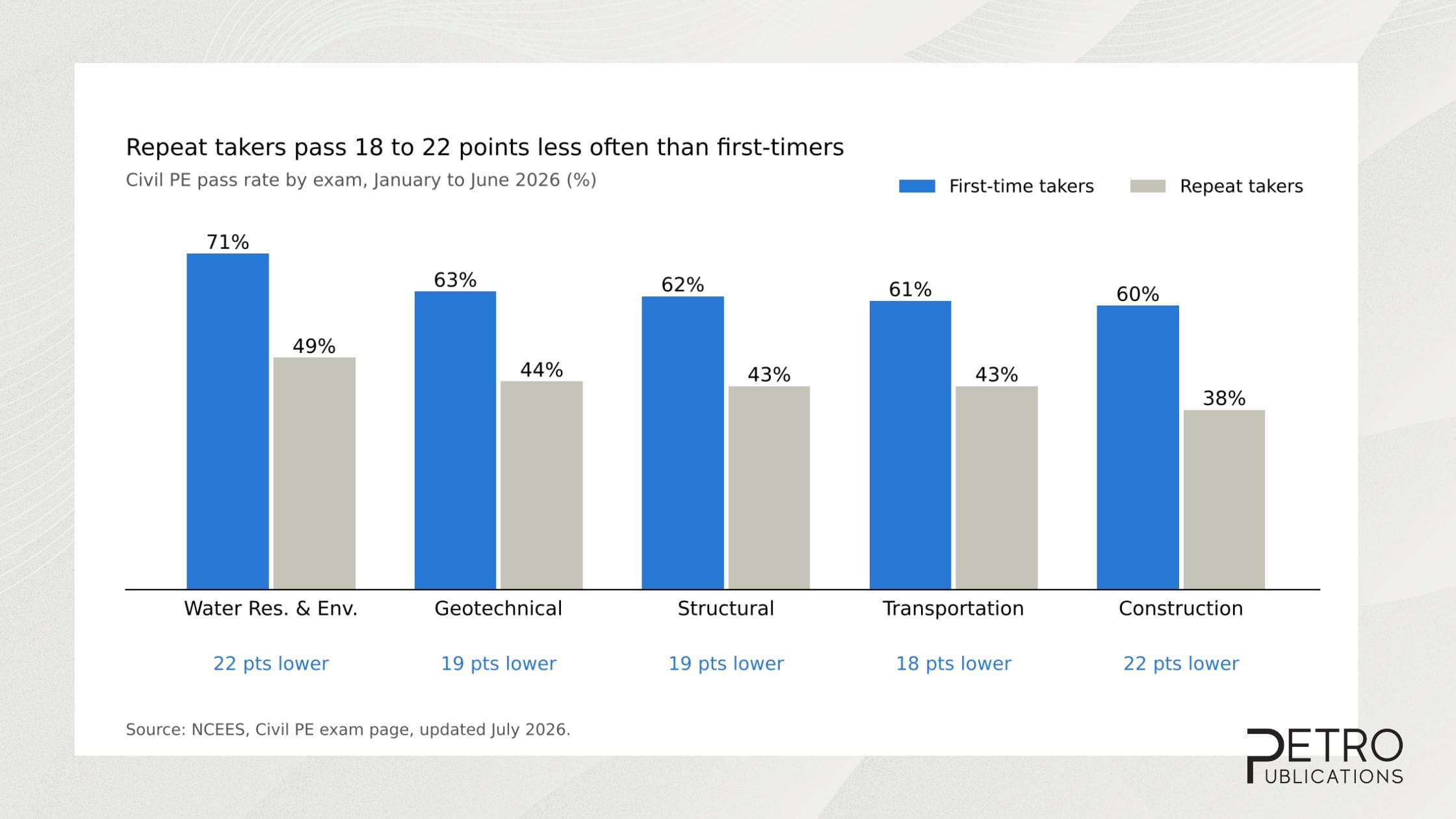
Most first-time candidates pass. In its July 2026 update, NCEES reported first-time Civil PE pass rates of 60% to 71% (about 65% overall) and repeat rates of 38% to 49% (about 44% overall). Use the first-time rates for planning, choose your discipline by your work rather than by pass rate, and check back each January and July when NCEES updates the figures.
How Is California Different?
California requires civil engineering applicants to pass two state-specific exams, Seismic Principles and Engineering Surveying, in addition to the NCEES FE and PE Civil exams. According to BPELSG, the sequence works like this:
- Pass the FE exam (unless you qualify for an FE waiver) and the NCEES PE Civil exam, and confirm that you meet the Board’s qualifying experience requirements.
- Submit your licensure application in BPELSG Connect. There is no final filing date.
- Request and pay for the state exams in BPELSG Connect once your application is approved in technical review.
- Choose a quarter. You test in one of the two quarters after the quarter in which you paid, never the same one. Pay in Quarter 1, for example, and you can test in Quarter 2 or Quarter 3.
- Schedule with Prometric after you receive your Authorization to Test emails.
- Receive your results by email, typically by mid-month following the month you tested. The exams are not appealable or reviewable.
| Item | California Seismic Principles and Engineering Surveying |
|---|---|
| Format | Multiple choice, computer-based, may include alternative item types |
| Length | 2.5 hours per exam |
| Where | Prometric test centers |
| Offered | Quarterly, on a continuous basis |
| Board resources | Test plans (2022), retired sample questions, a recommended reference list, and a Candidate Information Bulletin to read before test day |
| Seismic code basis | ASCE 7-16 was still the referenced standard as of July 2026, and BPELSG had not announced when it will adopt ASCE 7-22 (confirm in the current bulletin) |
Sources: BPELSG exam candidate information and applying for licensure as a civil engineer.
How Hard are California’s State Exams?
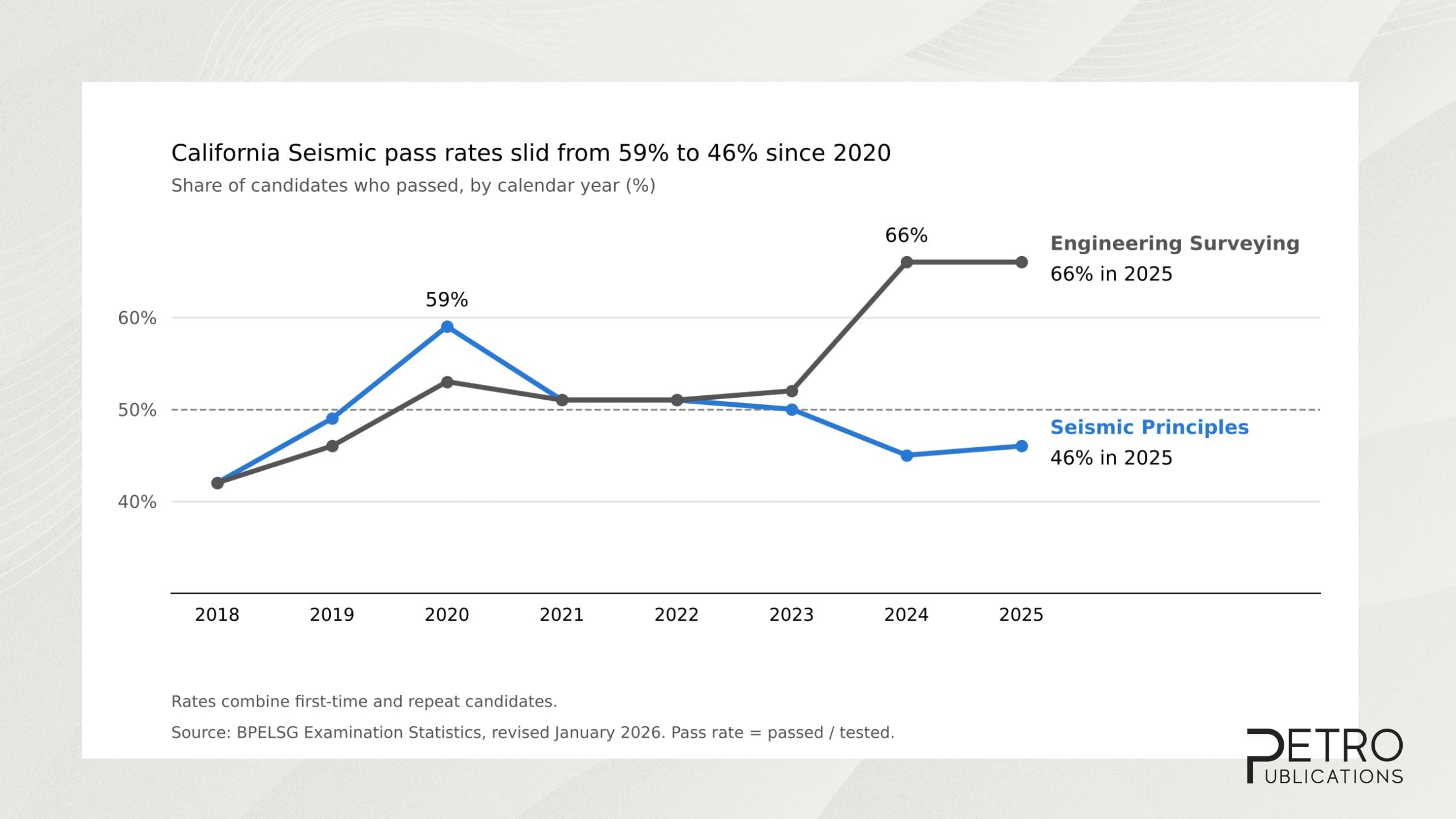
Seismic Principles is the tougher of the two. BPELSG reported that 46% of candidates passed it in 2025, compared with 66% for Engineering Surveying. These rates combine first-time and repeat candidates, so they are not directly comparable to the NCEES rates above.
Planning tip: Because the quarter rules build in waiting time, start preparing for the state exams as soon as your application is approved, not after a first attempt.
What Is Changing for the Civil PE Exam in 2027?
NCEES is updating the design standards for every Civil PE exam beginning with the April 2027 exam. Specifications and standards are posted six months before they take effect. The specifications themselves change only every 5 to 7 years, while design standards change more often, which is why these updates feel like a smaller reset than they are.
| Discipline | Where the 2027 change is largest |
|---|---|
| Structural | The biggest revision: about ten primary references updated, including ASCE 7, ACI 318, AISC, IBC, AASHTO LRFD, AWC, PCI, and TMS |
| Water Resources and Environmental | Mostly added references (OSHA, FHWA, USACE, UFC) rather than a change in methods |
| Transportation | Highway Capacity Manual and MUTCD updates |
| Construction | MUTCD Part 6 and OSHA updates |
| Geotechnical | UFC 3-220-20 (2025) replaces NAVFAC DM 7.02 (1986); ASCE 7 site classes updated |
Why the edition matters: NCEES scores solutions that rely on a referenced standard against the edition on its list, and solutions based on other standards do not receive credit. Study from the edition list for the month you plan to test. For a deeper look, read our summaries of the 2027 specification changes, ASCE 7-22, and ACI 318-19, and our advice on whether you can still use old reference manuals.
Are There Any Tips for Preparing for the PE Exam?
Yes. These eight habits come up again and again among candidates who pass, and each one is something you can start this week.
- Choose your discipline by your work, not by pass rate. A higher pass rate may only reflect who chooses that exam. Pick the exam whose topics you already use on the job.
- Set a test date, then work backward. Our study schedule guide suggests about 100 hours for an experienced engineer, 150 for someone in the same discipline, 220 for a recent graduate, and 250 for a change of discipline.
- Take a baseline early. The NCEES practice exam is available in your MyNCEES account. Take it in the first two weeks, with the handbook open, to see which areas actually cost you time rather than which ones feel weak.
- Learn your references before you grind problems. With about 6 minutes per question on average, finding the right table or procedure is half the work.
- Solve enough quality questions, and review every miss. We recommend at least 240 quality questions, with 400 to 450 as a strong target (see how many practice questions to solve). Label each miss as a knowledge gap, a wrong equation, a unit error, a misread question, or a time problem. Each label points to a different fix.
- Practice under exam conditions. Work timed sets of 20 questions in 120 minutes, and schedule at least one full 80-question, 8-hour simulation, with a break, in the last three weeks. Endurance is a skill, and you only build it by sitting through it.
- Study the edition you will be tested on. Check the standards list for your test date, especially if you test around April 2027.
- Be selective about question sources. Cheap and unreviewed question banks, including AI-generated ones, can contain errors and unrealistic assumptions. A few hundred reviewed questions beat a thousand questionable ones.
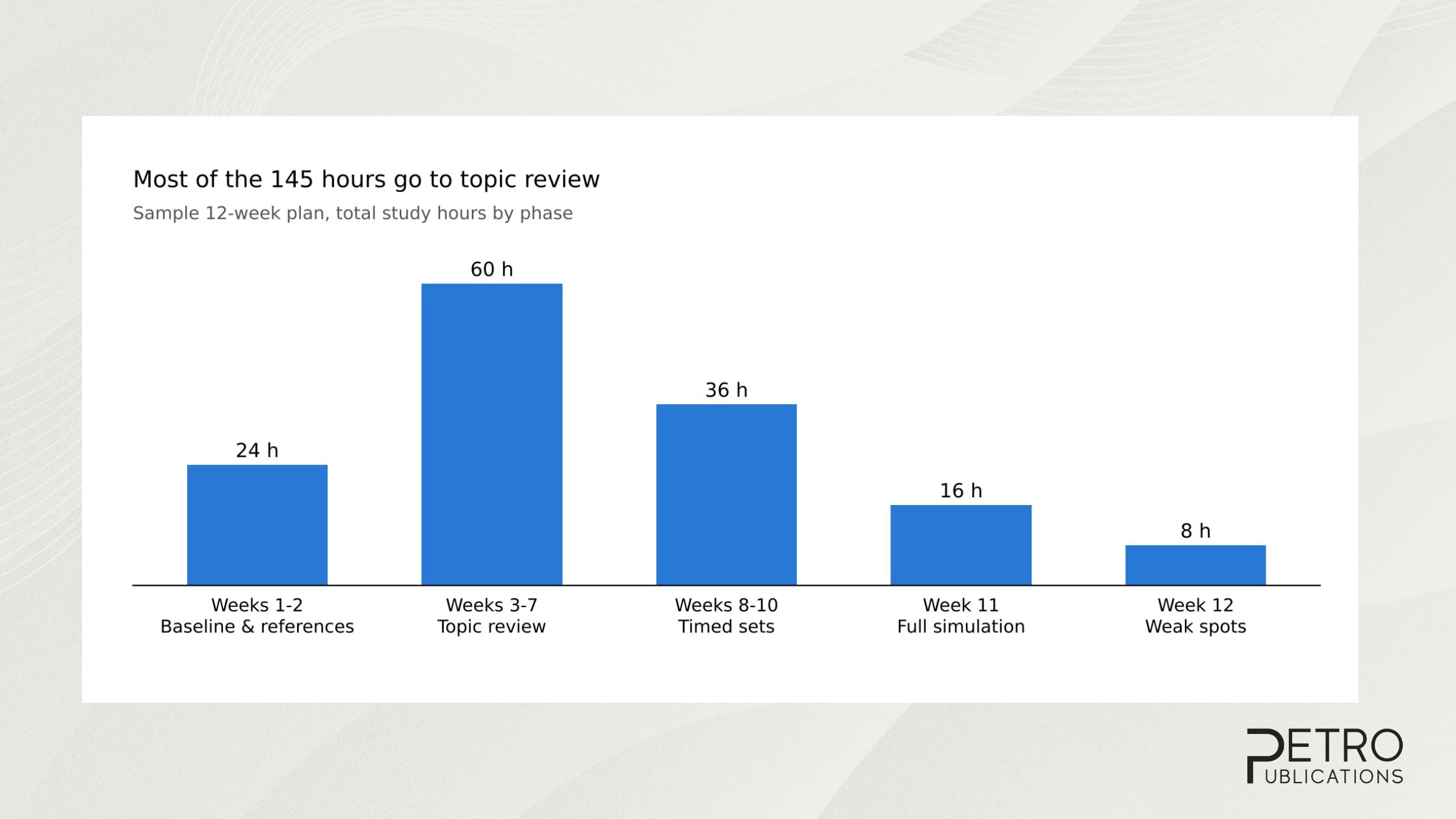
A Sample 12-week Plan (About 145 Hours)
Use this as a starting framework and adjust it to your background and your discipline’s reference load.
| Weeks | Focus | Hours per week | Total hours |
|---|---|---|---|
| 1 to 2 | Baseline NCEES practice exam, reference map, practice searching the PDFs | 12 | 24 |
| 3 to 7 | Topic review, weakest areas first, each followed by problems | 12 | 60 |
| 8 to 10 | Mixed timed sets of 20 questions in 120 minutes, error log review | 12 | 36 |
| 11 | Full 80-question, 8-hour simulation, then a careful review | 16 | 16 |
| 12 | Weak-spot review, exam-day logistics, rest | 8 | 8 |
Read more about what you actually need regarding PE exam preparation materials.
What Mistakes Do PE Candidates Make?
You can now answer “What is the PE exam?” but here are common errors that candidates make that you should know about:
- Studying from outdated editions. Concepts carry over, but procedures and tables may not.
- Collecting questions instead of learning from them. Finishing a bank is not the goal. Understanding why each answer is right is.
- Assuming the exam is “open book,” so lookup will be easy. Speed of lookup in a searchable PDF is a skill that needs practice.
- Skipping timed practice. Fatigue by hour six changes how well you read and calculate.
- Choosing a discipline from the pass-rate table. Choose the one you work in.
- Waiting too long on California’s state exams. You must request and pay for them in one quarter and test in a later one, so a retake can add several months to your licensing timeline.
If the exam does not go your way, our retake study plan explains how to use your NCEES diagnostic report to rebuild your preparation.
How Do You Maintain Your PE License?
Earning the license is only half the job. To keep it active, you renew it on your board’s schedule, usually every one to three years, and in most states you also complete continuing education. Continuing education is measured in professional development hours (PDHs), where one PDH is generally one hour of qualifying instruction or activity.
Many boards also require some of those hours to cover ethics or professional practice, accept only approved course providers, and can audit your records, so keep your certificates. A license that is not renewed on time can lapse, and practicing on a lapsed license can lead to discipline.
Requirements differ by state. 42 states and Washington, D.C. require continuing education for PE renewal, and eight states do not. The table below shows the hours each state requires per renewal period.
Several states have extra rules, such as ethics hours or a minimum number of live hours, so confirm the details with your board before you renew.
| Do you need PDHs to renew? | States |
|---|---|
| No continuing education required | Arizona, California, Colorado, Connecticut, Hawaii, Massachusetts, Rhode Island, Washington |
| Yes, 15 PDH per year | Georgia, Mississippi, North Carolina |
| Yes, 16 PDH per two years | Maryland, Virginia |
| Yes, 18 PDH per two years | Florida |
| Yes, 20 PDH per two years | District of Columbia |
| Yes, 24 PDH per two years | Alaska, Delaware, Idaho, Minnesota, New Jersey, Pennsylvania, Tennessee |
| Yes, 30 PDH per two years | Alabama, Arkansas, Illinois, Indiana, Iowa, Kansas, Kentucky, Louisiana, Maine, Michigan, Missouri, Montana, Nebraska, Nevada, New Hampshire, New Mexico, North Dakota, Ohio, Oklahoma, Oregon, South Carolina, South Dakota, Utah, Vermont, West Virginia, Wisconsin, Wyoming |
| Yes, 36 PDH per three years | New York |
| Yes, hours changing | Texas (moving to a biennial cycle; check the Texas board for the current hours) |
PE Exam Planning Tip
If you hold licenses in more than one state, each board has its own renewal date and rules, and some accept hours earned for another state while others do not. Track each license separately and spread your PDHs across the renewal period instead of leaving them for the last month.
Frequently Asked Questions About the PE Exam
PE stands for Principles and Practice of Engineering. It is the NCEES exam that follows the FE exam and, together with experience and your board’s approval, leads to a Professional Engineer license.
The Civil PE has 80 questions. The appointment lasts 9 hours: a 2-minute NDA, an 8-minute tutorial, an 8-hour exam, and a 50-minute scheduled break.
In the January to June 2026 window, NCEES reported first-time pass rates of 60% to 71% and repeat pass rates of 38% to 49% across the five Civil exams. Weighted by examinee volume, that works out to about 65% for first-time takers and 44% for repeat takers. NCEES updates these figures every January and July.
The right number depends on your background. We suggest roughly 100 hours for an experienced engineer in the same discipline and up to 250 for someone changing disciplines. A 12-week plan at about 12 hours per week totals roughly 145 hours.
NCEES Civil PE exam: No. NCEES provides an electronic reference handbook and the design standards listed in your exam specification, as searchable PDFs inside the exam software. NCEES states these are the only reference materials allowed, and you may not bring personal copies of any material into the exam room.
California Seismic Principles and Engineering Surveying exams: Yes, with limits. The BPELSG exams are not open to the same degree as the NCEES exam.
According to the Prometric Candidate Information Bulletin (CIB), you may bring as many reference materials as fit in one trip and one box, no larger than 10″ high x 15″ wide x 24″ deep. All reference materials, including all forms of notes, must be bound and stay bound during the exam. Slide charts, wheel charts, and blank or unbound notes are not allowed. Post-its are allowed only as book tabs, and they must be attached before you enter the test center. You may also bring any two of these measuring devices: a ruler, a protractor, an architect scale, or an engineer scale. Prometric provides two scratch paper booklets and pencils, and you may not bring your own scratch paper.
Tip: BPELSG recommends printing the CIB and bringing a copy to the test center.
NCEES Civil PE exam: NCEES allows only calculators from its approved list. If a model is not on the list, you cannot use it. The approved families are:
Casio: all fx-115 and fx-991 models.
Hewlett-Packard: the HP 33s and HP 35s only.
Texas Instruments: all TI-30X and TI-36X models.
You may bring a primary calculator and, for most candidates, a backup, which must also be an approved model. Calculators with wireless communication, external memory, or stored notes or reference material are prohibited. Proctors may inspect your calculator, ask you to clear its memory, or hold it if it is not approved.
California Seismic Principles and Engineering Surveying exams: The rules are different. The CIB limits you to two calculators in the testing area. You may use any handheld calculator except those with a QWERTY keypad. Smartwatches, palmtops, laptops, computers, PDAs, organizers, and tablets are prohibited. Calculators with other alphanumeric keypads are acceptable, and you are responsible for confirming that yours qualifies. This means a calculator that is not allowed on the NCEES exam may be allowed on the California exams.
NCEES policy provides one attempt per testing window and no more than three attempts in a 12-month period. Your state board may add its own rules, so confirm them before you register.
California civil engineering applicants must also pass the Seismic Principles and Engineering Surveying exams. Each is a 2.5-hour, computer-based exam administered by BPELSG at Prometric test centers.
NCEES is updating the design standards for every Civil PE exam beginning with the April 2027 exam. Structural has the largest set of changes, while Geotechnical, Transportation, Construction, and Water Resources and Environmental see more focused updates.
California’s state exams are changing too: BPELSG is also updating the Seismic Principles and Engineering Surveying exams in early 2027. California candidates should check the current BPELSG Candidate Information Bulletin and test plans for the exact content and reference changes before choosing a test quarter.
The license lets you sign and seal engineering work for the public, supervise other engineers, and, in many states, run your own practice. It also makes you personally accountable for the safety of your designs.
Renew it on your board’s schedule and, in most states, complete the required PDHs. Most states ask for 24 to 30 PDHs every two years. Eight states, including California, do not require continuing education to renew. Check your board for your exact requirements.
NCEES gives you a diagnostic report showing your performance in each major topic area. Use it to focus your retake preparation instead of restarting from the beginning.
Prepare With Petro Publications Study Guides and Practice Exams
Go beyond this simple guide that gives you the answer to “What is the PE exam?” Get started with study guides and practice exams.
Petro Publications offers Civil PE exam study guides that are always up to date, along with realistic online practice exams for each Civil discipline. For California candidates, we also publish Seismic Principles and Engineering Surveying reference guides and practice exams. Get them individually or in study bundles designed to build your confidence and your speed before exam day.
