
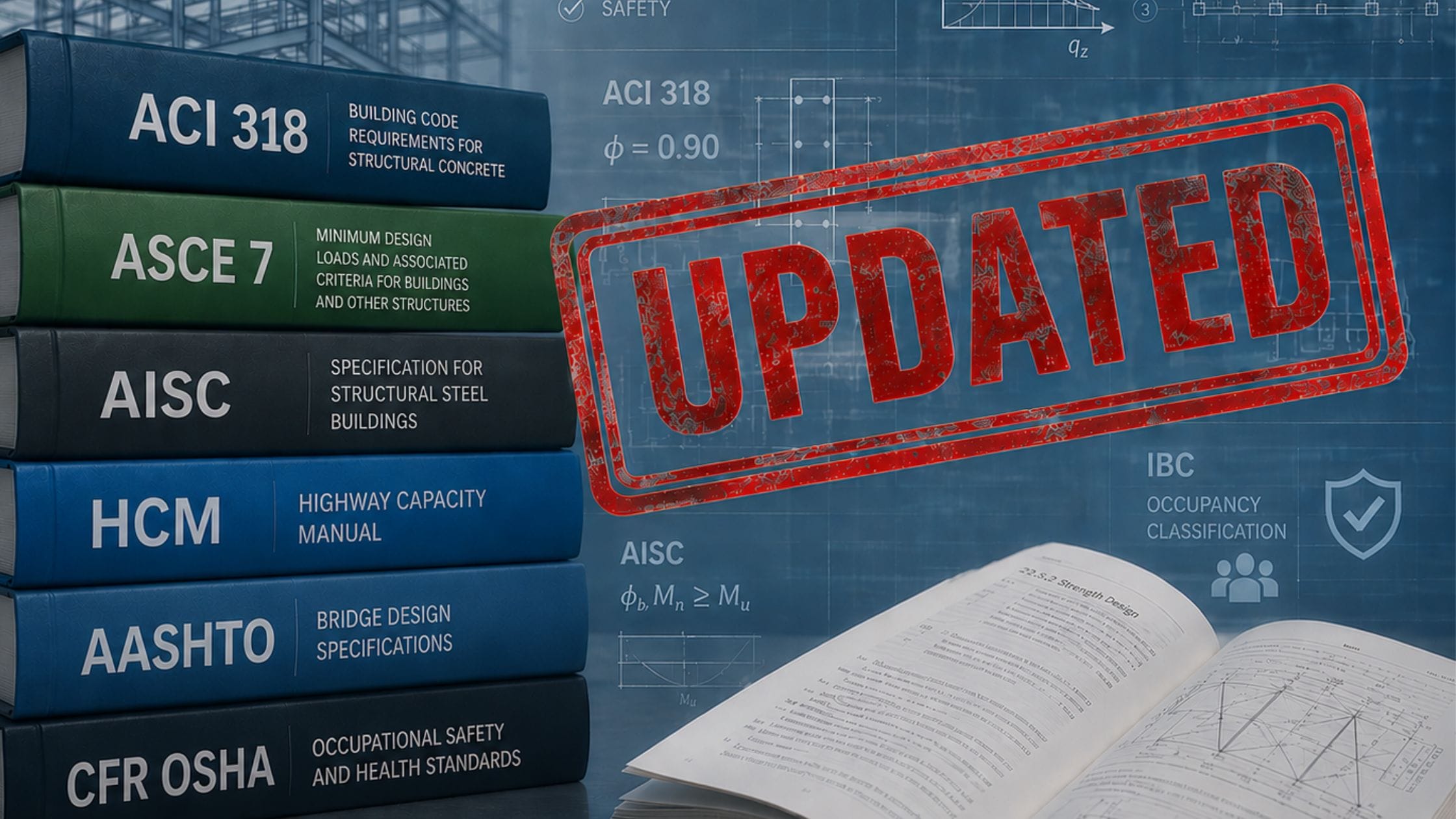
NCEES Civil PE Exam Specification Changes in 2027: What Engineers Need to Know

NCEES is updating the Civil PE exam specifications in April 2027. For quick reference, detailed comparison tables are included at the end of this article.

Naturally, many engineers preparing for licensure have started asking what these changes mean for their PE exam eligibility, PE exam study schedule, and overall exam preparation strategy.

Many Civil PE references are already reasonably modern and continue to serve their purpose well. The 2027 revisions do not represent a complete overhaul of the NCEES civil PE exam specifications, but rather a selective modernization of codes and standards where newer editions improve clarity, usability, or better reflect current engineering practice.

Structural Civil PE Exam Standard Changes

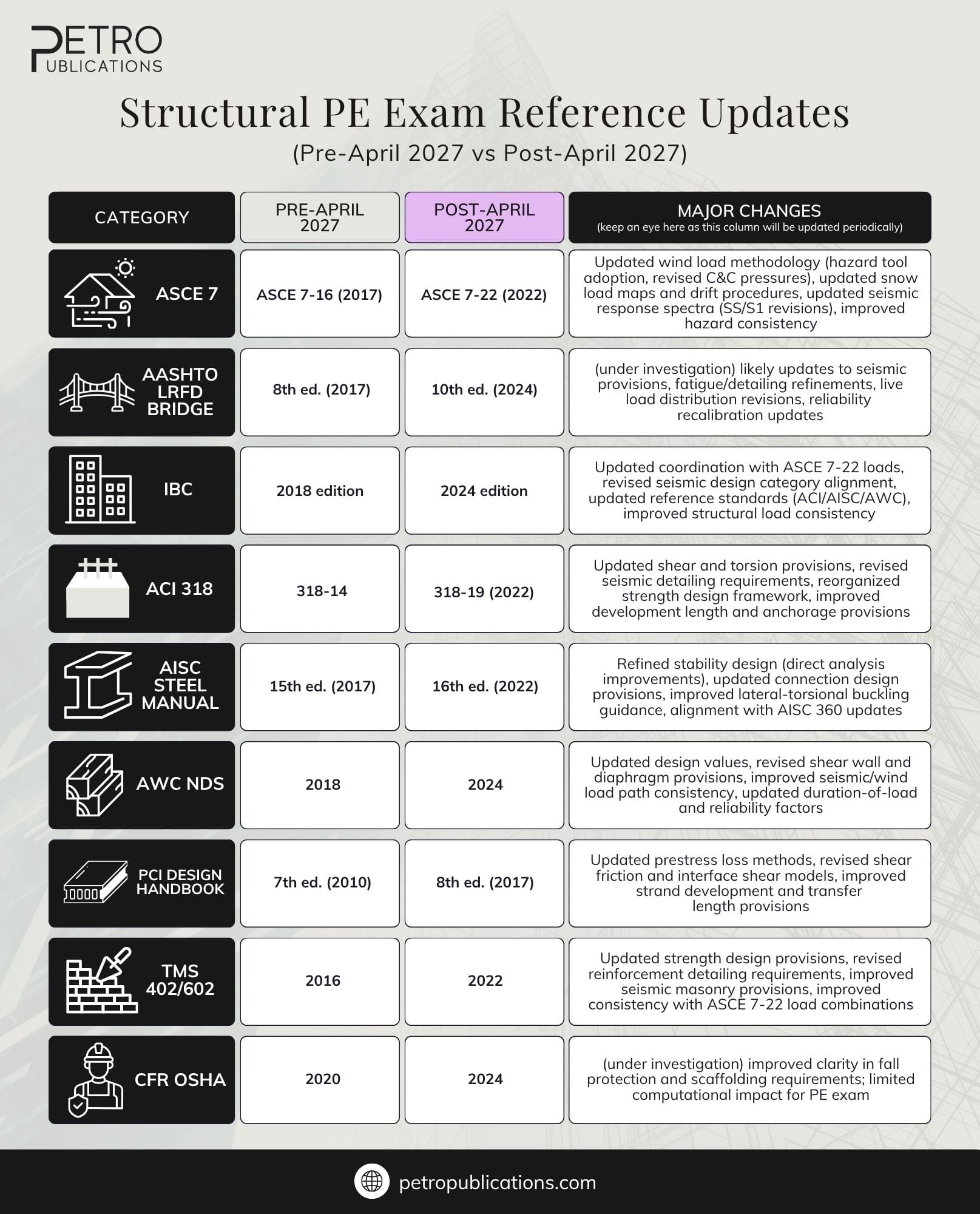
The most significant impact occurs within the NCEES Civil Structural PE exam.

This discipline experiences the largest revision among all Civil PE specifications, with nearly every major structural code receiving an update. Approximately ten primary references were revised, including AASHTO LRFD, IBC, ASCE 7, ACI 318, AISC, AWC, PCI, TMS, and OSHA-related standards. As a result, candidates preparing for the PE structural exam content will likely experience the greatest transition burden and may need to revisit portions of their PE exam study priorities and realistic PE test prep approach.
Water Resources and Environmental Civil PE Exam Standards Changes

The second most noticeable impact occurs within the NCEES Civil Water Resources and Environmental PE Exam.

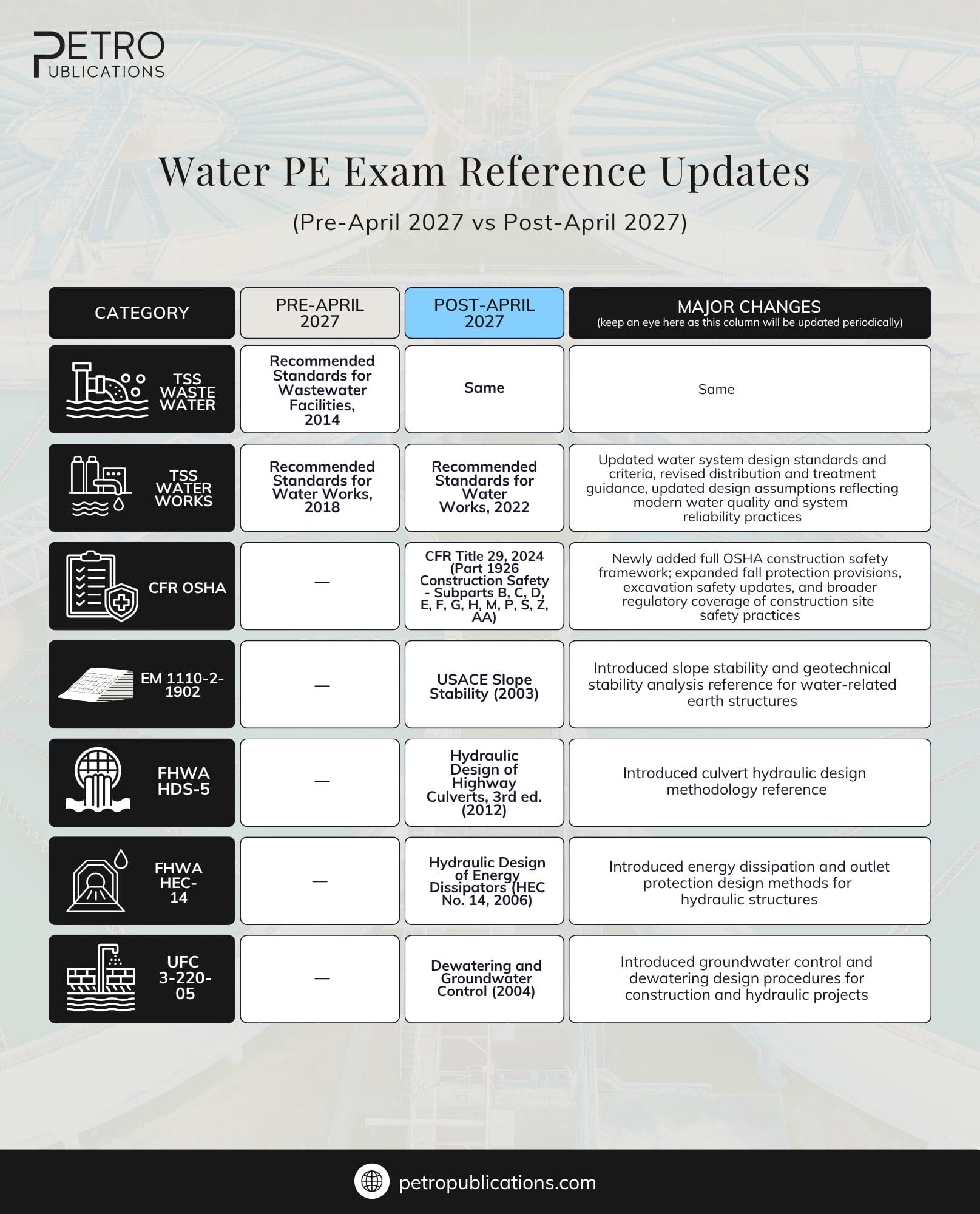
Interestingly, the major change here is not necessarily the underlying standards themselves, but rather the expansion of references. While the States Standards remain largely stable, the updated specifications add several new OSHA, FHWA, USACE, and UFC references. Therefore, the water resources PE exam content experiences a broader reference framework rather than a complete shift in engineering methodology.
Transportation and Construction Civil PE Exam Standard Changes

Transportation and Construction experience moderate but meaningful revisions.

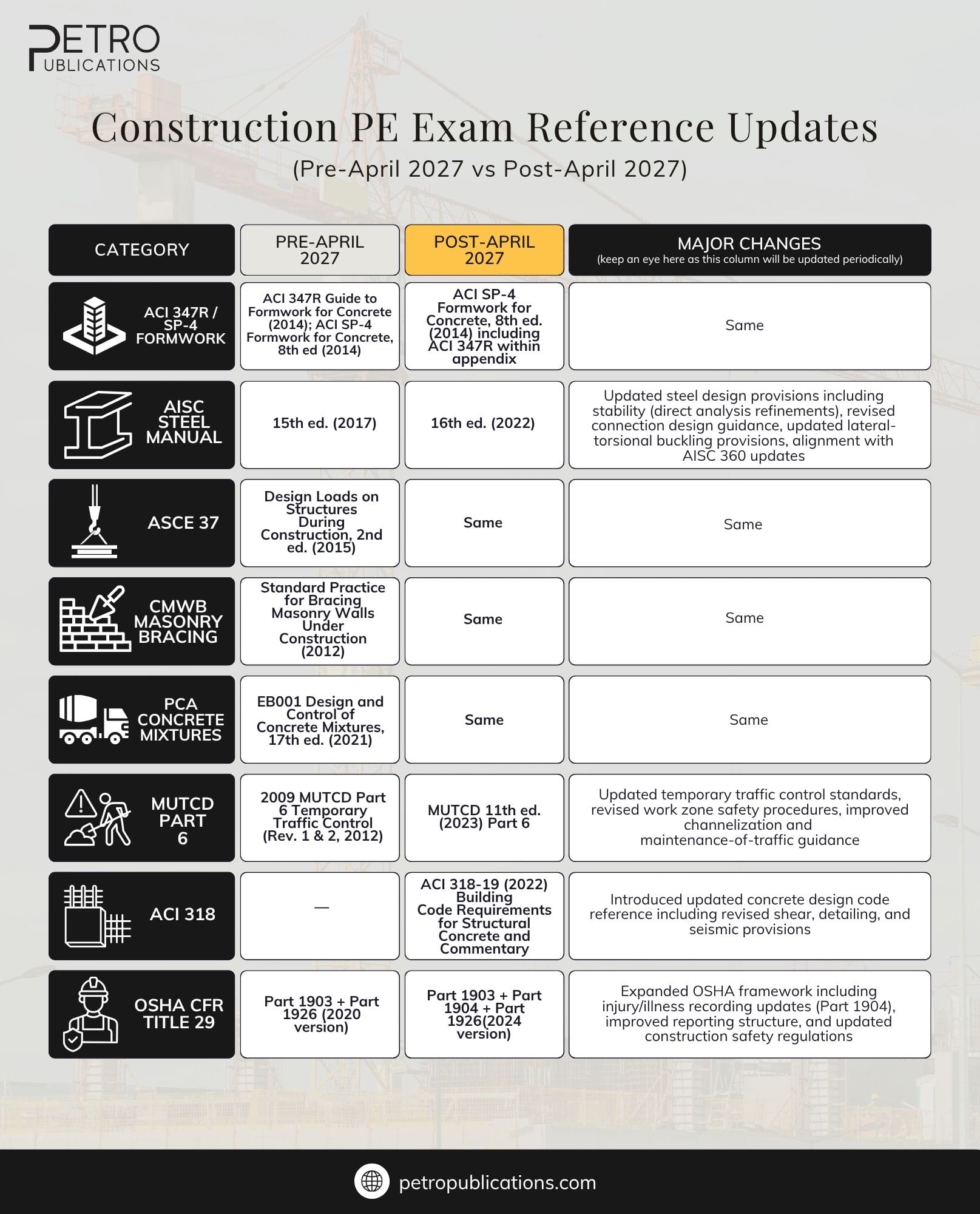
For the NCEES Civil Transportation PE exam and NCEES Civil Construction PE specifications, most long-standing references remain intact. The primary transportation update involves the Highway Capacity Manual (HCM) together with the Manual on Uniform Traffic Control Devices (MUTCD). Likewise, Construction is significantly affected through the MUTCD Part 6 revision and OSHA updates. Since traffic control and temporary traffic control guidance remain heavily dependent on MUTCD interpretation, these revisions deserve attention when updating a study plan for PE exam preparation and selecting the most effective PE exam prep methods.
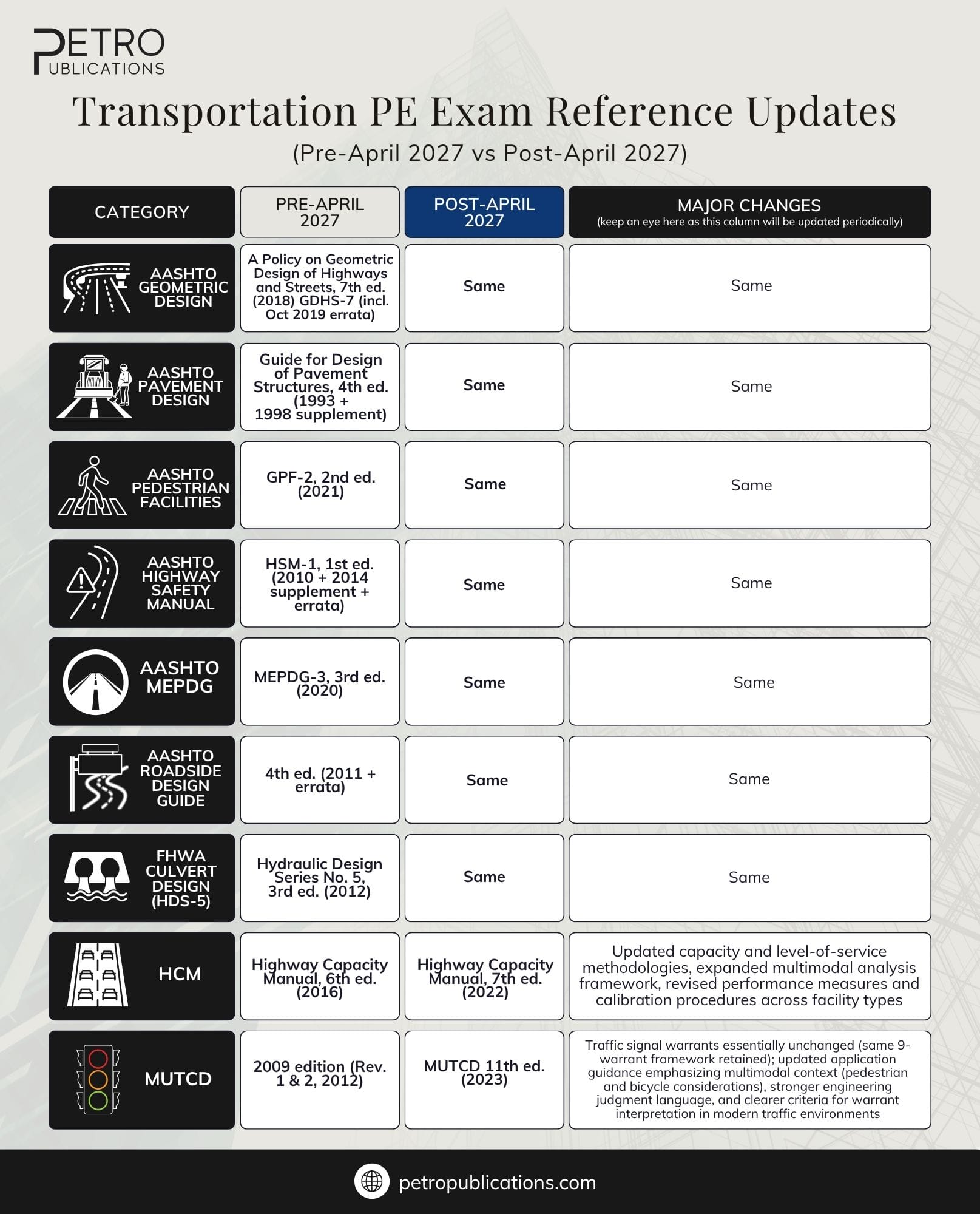
In Transportation specifically, the MUTCD update modernizes application while largely retaining the familiar warrant framework that you receive several questions on during examination. Likewise, the HCM update introduces revised methodologies and multimodal considerations that may influence portions of the transportation PE exam content.
Geotechnical Civil PE Exam Standard Changes

In my opinion, the Geotechnical examination experiences the least disruptive effect from the 2027 updates.

One reference has always stood out to me because of its age. Under the pre-2027 specifications, Geotechnical still referenced NAVFAC DM 7.02 originally published in 1986. Beginning in April 2027, candidates will instead use UFC 3-220-20 (2025). Frankly, this update was overdue.

The difference is substantial. The newer UFC reference is clearer, better organized, and incorporates more modern engineering examples and engineering practice. That said, I would characterize the overall geotechnical impact as relatively elastic. Much of the information contained in the updated UFC document already overlaps with material found in other FHWA, UFC, and USACE references that remain unchanged. In other words, while the reference itself is greatly improved, the underlying body of geotechnical knowledge remains comparatively stable.

The ASCE update within Geotechnical deserves mention as well. The changes most relevant to geotechnical engineering involve Chapter 20 site classifications, including intermediate soil classes such as BC, CD, and DE together with refinements to seismic site characterization procedures.

This discussion does not include the California PE exam, California Civil Seismic exam, or California engineering surveying exam review requirements. However, California candidates should recognize that future ASCE-related updates may ultimately carry more significant implications once adopted within California seismic design and California civil engineering surveying exam frameworks.
How To Prepare For The 2027 NCEES Civil PE Exam Changes

Overall, the 2027 NCEES PE exam updates do not affect all disciplines equally.

Structural candidates face the largest transition due to widespread code revisions. Water Resources experiences the largest expansion of references. Transportation and Construction encounter focused but important revisions centered primarily on MUTCD, HCM, and OSHA modernization. Geotechnical, while benefiting from long-overdue UFC improvements, remains comparatively stable.

As the PE exam evolves, updates like these help align PE exam preparation more closely with modern engineering practice. Whether you are evaluating PE exam difficulty, planning average study time for the PE exam, building a PE prep timeline, selecting PE practice exams, or simply reviewing the NCEES PE reference handbook and NCEES civil exam specifications, understanding these reference changes early can help create a more realistic and effective preparation strategy.

Comparison Tables:

Structural PE Exam Reference Updates (Pre-April 2027 vs Post-April 2027)

Category Pre-April 2027 Post-April 2027 Major changes (keep an eye here as this column will be updated periodically)
ASCE 7 ASCE 7-16 (2017) ASCE 7-22 (2022) Updated wind load methodology (hazard tool adoption, revised C&C pressures), updated snow load maps and drift procedures, updated seismic response spectra (SS/S1 revisions), improved hazard consistency
AASHTO LRFD Bridge 8th ed. (2017) 10th ed. (2024) (under investigation) likely updates to seismic provisions, fatigue/detailing refinements, live load distribution revisions, reliability recalibration updates
IBC 2018 edition 2024 edition Updated coordination with ASCE 7-22 loads, revised seismic design category alignment, updated reference standards (ACI/AISC/AWC), improved structural load consistency
ACI 318 318-14 318-19 (2022) Updated shear and torsion provisions, revised seismic detailing requirements, reorganized strength design framework, improved development length and anchorage provisions
AISC Steel Manual 15th ed. (2017) 16th ed. (2022) Refined stability design (direct analysis improvements), updated connection design provisions, improved lateral-torsional buckling guidance, alignment with AISC 360 updates
AWC NDS 2018 2024 Updated design values, revised shear wall and diaphragm provisions, improved seismic/wind load path consistency, updated duration-of-load and reliability factors
PCI Design Handbook 7th ed. (2010) 8th ed. (2017) Updated prestress loss methods, revised shear friction and interface shear models, improved strand development and transfer length provisions
TMS 402/602 2016 2022 Updated strength design provisions, revised reinforcement detailing requirements, improved seismic masonry provisions, improved consistency with ASCE 7-22 load combinations
CFR OSHA 2020 2024 (under investigation) improved clarity in fall protection and scaffolding requirements; limited computational impact for PE exam


Transportation PE Exam Reference Updates (Pre-April 2027 vs Post-April 2027)

Category Pre-April 2027 Post-April 2027 Major changes (keep an eye here as this column will be updated periodically)
AASHTO Geometric Design A Policy on Geometric Design of Highways and Streets, 7th ed. (2018) GDHS-7 (incl. Oct 2019 errata) Same Same
AASHTO Pavement Design Guide for Design of Pavement Structures, 4th ed. (1993 + 1998 supplement) Same Same
AASHTO Pedestrian Facilities GPF-2, 2nd ed. (2021) Same Same
AASHTO Highway Safety Manual HSM-1, 1st ed. (2010 + 2014 supplement + errata) Same Same
AASHTO MEPDG MEPDG-3, 3rd ed. (2020) Same Same
AASHTO Roadside Design Guide 4th ed. (2011 + errata) Same Same
FHWA Culvert Design (HDS-5) Hydraulic Design Series No. 5, 3rd ed. (2012) Same Same
HCM Highway Capacity Manual, 6th ed. (2016) Highway Capacity Manual, 7th ed. (2022) Updated capacity and level-of-service methodologies, expanded multimodal analysis framework, revised performance measures and calibration procedures across facility types
MUTCD 2009 edition (Rev. 1 & 2, 2012) MUTCD 11th ed. (2023) Traffic signal warrants essentially unchanged (same 9-warrant framework retained); updated application guidance emphasizing multimodal context (pedestrian and bicycle considerations), stronger engineering judgment language, and clearer criteria for warrant interpretation in modern traffic environments


Water Resources and Environmental PE Exam Reference Updates (Pre-April 2027 vs Post-April 2027)

Category Pre-April 2027 Post-April 2027 Major changes (keep an eye here as this column will be updated periodically)
TSS Wastewater Recommended Standards for Wastewater Facilities, 2014 Same Same
TSS Water Works Recommended Standards for Water Works, 2018 Recommended Standards for Water Works, 2022 Updated water system design standards and criteria, revised distribution and treatment guidance, updated design assumptions reflecting modern water quality and system reliability practices
CFR OSHA — CFR Title 29, 2024 (Part 1926 Construction Safety – Subparts B, C, D, E, F, G, H, M, P, S, Z, AA) Newly added full OSHA construction safety framework; expanded fall protection provisions, excavation safety updates, and broader regulatory coverage of construction site safety practices
EM 1110-2-1902 — USACE Slope Stability (2003) Introduced slope stability and geotechnical stability analysis reference for water-related earth structures
FHWA HDS-5 — Hydraulic Design of Highway Culverts, 3rd ed. (2012) Introduced culvert hydraulic design methodology reference
FHWA HEC-14 — Hydraulic Design of Energy Dissipators (HEC No. 14, 2006) Introduced energy dissipation and outlet protection design methods for hydraulic structures
UFC 3-220-05 — Dewatering and Groundwater Control (2004) Introduced groundwater control and dewatering design procedures for construction and hydraulic projects


Construction PE Exam Reference Updates (Pre-April 2027 vs Post-April 2027)


Category Pre-April 2027 Post-April 2027 Major changes (keep an eye here as this column will be updated periodically)
ACI 347R / SP-4 Formwork ACI 347R Guide to Formwork for Concrete (2014); ACI SP-4 Formwork for Concrete, 8th ed. (2014) ACI SP-4 Formwork for Concrete, 8th ed. (2014) including ACI 347R within appendix Same
AISC Steel Manual 15th ed. (2017) 16th ed. (2022) Updated steel design provisions including stability (direct analysis refinements), revised connection design guidance, updated lateral-torsional buckling provisions, alignment with AISC 360 updates
ASCE 37 Design Loads on Structures During Construction, 2nd ed. (2015) Same Same
CMWB Masonry Bracing Standard Practice for Bracing Masonry Walls Under Construction (2012) Same Same
PCA Concrete Mixtures EB001 Design and Control of Concrete Mixtures, 17th ed. (2021) Same Same
MUTCD Part 6 2009 MUTCD Part 6 Temporary Traffic Control (Rev. 1 & 2, 2012) MUTCD 11th ed. (2023) Part 6 Updated temporary traffic control standards, revised work zone safety procedures, improved channelization and maintenance-of-traffic guidance
ACI 318 — ACI 318-19 (2022) Building Code Requirements for Structural Concrete and Commentary Introduced updated concrete design code reference including revised shear, detailing, and seismic provisions
OSHA CFR Title 29 Part 1903 + Part 1926 (2020 version) Part 1903 + Part 1904 + Part 1926 (2024 version) Expanded OSHA framework including injury/illness recording updates (Part 1904), improved reporting structure, and updated construction safety regulations


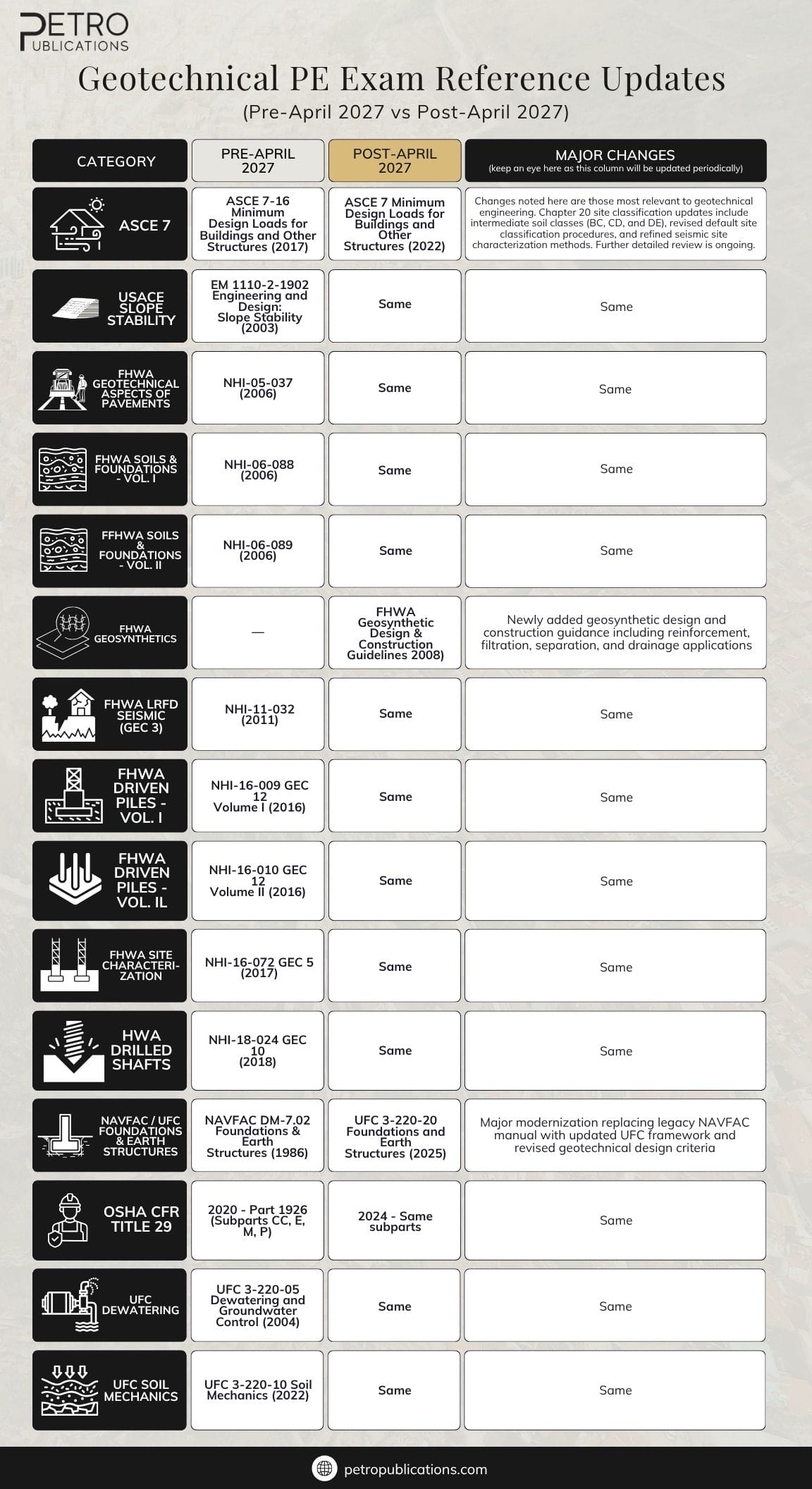
Geotechnical PE Exam Reference Updates (Pre-April 2027 vs Post-April 2027)

Category Pre-April 2027 Post-April 2027 Major changes (keep an eye here as this column will be updated periodically)
ASCE 7 ASCE 7-16 Minimum Design Loads for Buildings and Other Structures (2017) ASCE 7 Minimum Design Loads for Buildings and Other Structures (2022) Changes noted here are those most relevant to geotechnical engineering. Chapter 20 site classification updates include intermediate soil classes (BC, CD, and DE), revised default site classification procedures, and refined seismic site characterization methods. Further detailed review is ongoing.
USACE Slope Stability EM 1110-2-1902 Engineering and Design: Slope Stability (2003) Same Same
FHWA Geotechnical Aspects of Pavements NHI-05-037 (2006) Same Same
FHWA Soils & Foundations – Vol. I NHI-06-088 (2006) Same Same
FHWA Soils & Foundations – Vol. II NHI-06-089 (2006) Same Same
FHWA Geosynthetics — FHWA Geosynthetic Design & Construction Guidelines (2008) Newly added geosynthetic design and construction guidance including reinforcement, filtration, separation, and drainage applications
FHWA LRFD Seismic (GEC 3) NHI-11-032 (2011) Same Same
FHWA Driven Piles – Vol. I NHI-16-009 GEC 12 Volume I (2016) Same Same
FHWA Driven Piles – Vol. II NHI-16-010 GEC 12 Volume II (2016) Same Same
FHWA Site Characterization NHI-16-072 GEC 5 (2017) Same Same
FHWA Drilled Shafts NHI-18-024 GEC 10 (2018) Same Same
NAVFAC / UFC Foundations & Earth Structures NAVFAC DM-7.02 Foundations & Earth Structures (1986) UFC 3-220-20 Foundations and Earth Structures (2025) Major modernization replacing legacy NAVFAC manual with updated UFC framework and revised geotechnical design criteria
OSHA CFR Title 29 2020 – Part 1926 (Subparts CC, E, M, P) 2024 – Same subparts Same
UFC Dewatering UFC 3-220-05 Dewatering and Groundwater Control (2004) Same Same
UFC Soil Mechanics UFC 3-220-10 Soil Mechanics (2022) Same Same

Petro Publications provides trusted exam prep guides and online practice exams to help engineering professionals prepare for licensure exams with confidence. Explore our study resources to strengthen your knowledge, assess your readiness, and take the next step toward earning your professional engineering license.

Follow us on LinkedIn and YouTube for the latest news.

Shopping Cart
Scroll to Top