

Purpose and Introduction
The purpose of this article is to discuss some of the most important ASCE 7-22 changes compared to ASCE 7-16. At the time of writing, ASCE 7-16 remains the version referenced for the NCEES Civil PE examinations administered before April 2027, and it is also the version currently used for the California Seismic Principles state examination. The California Board for Professional Engineers, Land Surveyors, and Geologists (BPELSG) has already announced that its examination specifications will be updated to adopt ASCE 7-22 in 2027.
ASCE 7 code establishes the minimum design loads and associated criteria for buildings and other structures. Once these loads are determined, they are transferred to the structural analysis and design process. In simple terms, this standard provides the procedures for determining and applying the various loads that act on a structure, including dead loads, live loads, soil loads, hydrostatic loads, flood loads, tsunami loads, tornado loads (newly introduced as a new chapter), ice loads, snow loads, rain loads, seismic loads, and wind loads. A quick review of the table of contents of ASCE 7 provides a good overview of the broad range of loading categories covered by this standard.
Although the overall scope of ASCE 7 has remained largely unchanged, several important procedures have been revised in the 2022 edition. Some changes are relatively minor and involve modifications to coefficients or numerical values in certain equations, while others fundamentally change the procedures used to determine and apply design loads.
ASCE 7-22 Changes: Three Types
The changes introduced in ASCE 7-22 can generally be divided into three categories:
- Minor numerical changes,
- Major procedure changes, and,
- The addition of a new items, such as a new type of a structure, or a new load case, or a new configuration or category, which were not in the previous version of ASCE.
The first category consists of relatively simple numerical revisions or maps’ refinements, such as changing a load combination factor, modifying a coefficient, or adjusting a percentage or numerical value within an existing equation. These revisions are generally straightforward because engineers rarely memorize every numerical value contained in the code. During an examination or in practice, these values are simply obtained directly from the applicable tables or equations. As a result, these types of changes typically require very little additional effort to learn or apply.
The second category consists of procedure changes, which are significantly more important because they modify the methodology used to determine or apply a particular load. These changes often require engineers to adopt an entirely new design process rather than simply substitute one numerical value for another. This is more prominent in the changes that occurred on snow loads, wind loads and seismic loads.
“For PE exam preparation, understanding the design procedure changes introduced in ASCE 7-22 is more important than memorizing updated coefficients or load factors”
The third category is the addition of new loads (e.g., tornado loads), or new types of structures (e.g., rigid vertical elements and flexible diaphragms, or the ground mounted fixed-tilt solar panel system, or corrugate steel tanks), or new load cases (e.g., the torsional load cases for wind loads), or others, which were not included in the previous versions of this standard.
Which Civil PE Exam This Change Will Impact
The changes introduced in ASCE 7-22 will not affect every Civil PE discipline to the same extent. Some disciplines rely heavily on the loading provisions contained in ASCE 7, while others reference only selected chapters. Consequently, the impact of these updates will vary depending on the civil PE exam being taken.
From the NCEES civil PE examinations, the Structural Civil PE Exam is expected to be the most significantly affected because it relies heavily on the determination and application of design loads. Engineers preparing for this exam should become familiar with the procedure changes discussed in this article, particularly those related to snow loads, seismic loads, wind loads, load combinations, rain loads, and other loading provisions.
The Geotechnical Civil PE Exam may also be affected, although to a lesser extent. Candidates should be aware of updates related to lateral soil loads, hydrostatic loads, seismic provisions and the newly introduced soil classifications.
For candidates preparing for the California Seismic Principles Exam, ASCE 7-22 will be implemented along with CBC 2025 in 2027.
Summary of the Major Changes
In the following sections, we will discuss some of the important changes introduced in ASCE 7-22. We will not cover every single modification in detail. Instead, we will focus on the high-level changes that may affect the Structural Civil PE Exam, Geotechnical Civil PE Exam, along with the specific chapters that are relevant to the California Seismic Principles Exam. The goal is to provide a high-level overview of the changes and highlight areas that may become important when future exams adopt the updated provisions.
Importance Factors
One of the major changes in Chapter 1 of ASCE 7 is the update and simplification of Table 1.5-2. In ASCE 7-16, this table provided the importance factors to be used for different loads, including ice, snow, and seismic loads. In ASCE 7-22, the importance factor for seismic loads remains in this table, while the importance factors for other loads are now addressed within their respective load chapters through the risk category provisions, as will be discussed later.
Table 1.5-2 Importance Factors taken from ASCE 7-16
| Risk Category | Snow Importance Factor | Ice Importance Factor (Thickness) | Ice Importance Factor (Wind) | Seismic Importance Factor |
| I | 0.80 | 0.80 | 1.00 | 1.00 |
| II | 1.00 | 1.00 | 1.00 | 1.00 |
| III | 1.10 | 1.15 | 1.00 | 1.25 |
| IV | 1.20 | 1.25 | 1.00 | 1.50 |
Table 1.5-2 Importance Factors taken from ASCE 7-22
| Risk Category | Seismic Importance Factor |
| I | 1.00 |
| II | 1.00 |
| III | 1.25 |
| IV | 1.50 |
This approach was already used for wind loads. In previous versions of ASCE 7, wind loads were determined based on the risk category, and a separate importance factor was not directly used for wind loads. This is why wind loads were not included in ASCE 7-16 Table 1.5-2. The same concept has now been extended to snow and ice loads.
Load Combinations
Pay close attention to this section because some load combination factors have changed. In addition, new loads have been introduced into certain load combinations, such as tornado loads.
Lateral Soil Load
The code modified the table that provides the minimum lateral soil loads by providing two separate categories: active pressure and passive pressure. Previously, this distinction was not provided in the table.
The chapter also introduced a new alternative procedure for evaluating water pressure in soil. This allows engineers to use alternative methods instead of only relying on the minimum values provided in the chapter.
Live Load
There were no major changes in this chapter compared with other sections. However, several updates were introduced, including the addition of some new live load, such as emergency vehicles garages, theater projections and control, roller skating rinks.
There were also some minor modifications related to minimum roof live loads and the application of live loads to alternating spans.
Snow Load
As discussed in the introduction of this chapter, the Importance Factor is no longer directly used in the snow load chapter. Instead, snow loads are now determined based on the risk category. A geodatabase is used for determining snow-related parameters with the ASCE Hazard Tool.
If you were familiar with previous editions of the ASCE 7 code, the snow load Importance Factor (Is) obtained from Chapter 1 was incorporated directly into the snow load calculations. Under ASCE 7-22, this approach has been replaced by a new hazard database that already incorporates the appropriate risk category, eliminating the need to manually apply an importance factor.
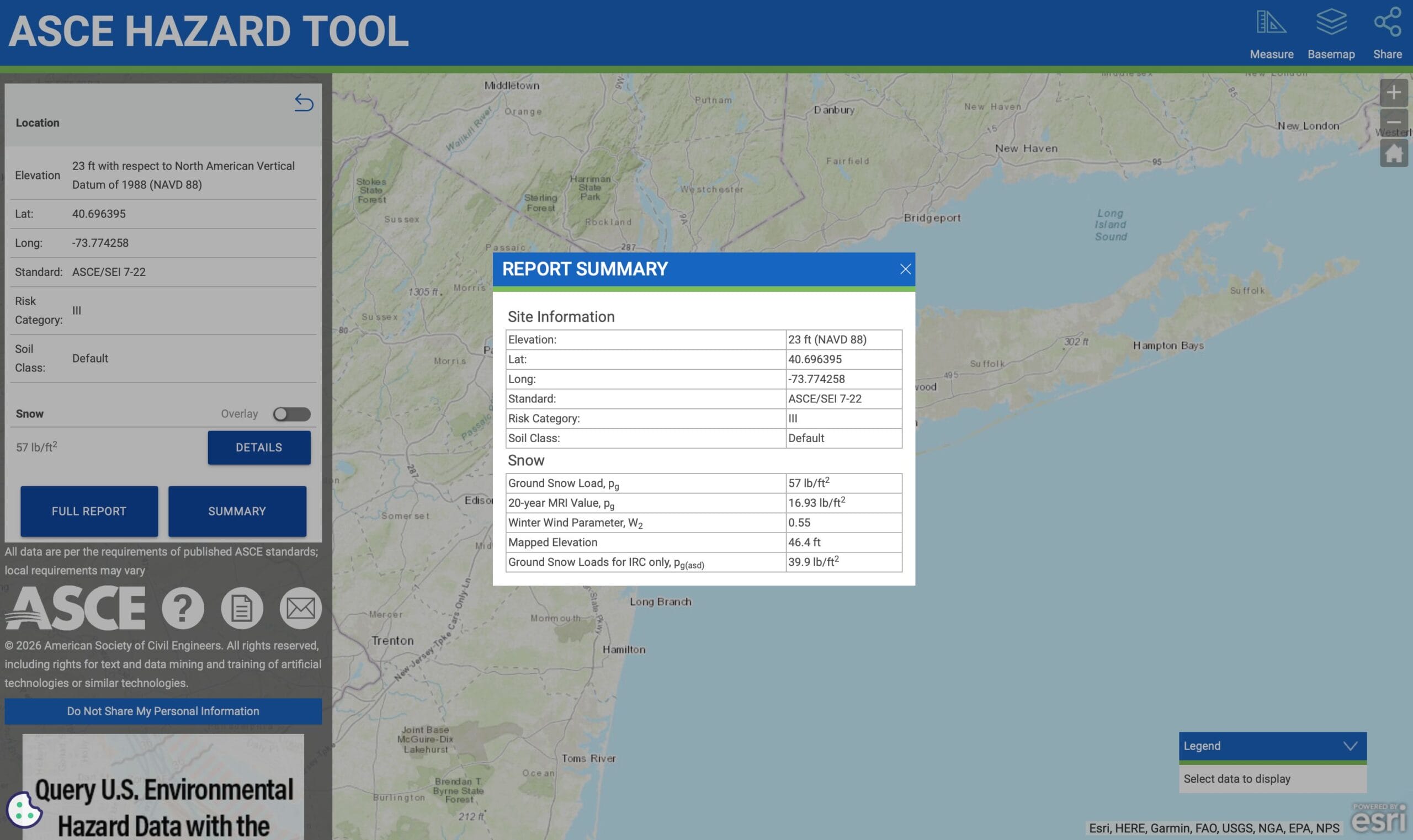
Additionally, the minimum snow loads are now compared against the minimum values specified for each risk category as follows:
| Risk Category | Minimum Snow Load |
| I | 25 psf |
| II | 30 psf |
| III | 35 psf |
| IV | 40 psf |
This approach was different in ASCE 7-16, where a single minimum value was provided as 20 psf multiplied by the snow load importance factor (Is).
Rain Load
A new parameter, the ponding depth (dp), has been introduced into the rain load equation to account for additional water accumulation.
The chapter also provides clearer criteria for when rain loads must be considered. For example, it defines conditions involving blockage of the primary drainage system, blockage of the secondary drainage system, the elevation difference of secondary drains, and whether multiple drainage systems share common lines.
The design storm return period has also been incorporated based on the risk category.
Seismic Load Provisions
The seismic chapters (Chapters 11 to 22) experienced some of the most significant changes in ASCE 7-22. Some chapters received major procedure updates, such as the procedure for determining the seismic coefficients in Chapter 11 and the procedure for nonstructural components in Chapter 13. Other chapters received other types of updates, including modifications to certain coefficients and factors, or the addition of new categories or new types of structures.
In previous versions of ASCE 7, seismic coefficients SMS and SM1 were determined using the site coefficients Fa and Fv as follows – which have been the basis for seismic load determination:
SMS = Fa SS
SM1 = Fv S1
In ASCE 7-22, the Fa and Fv site coefficients are no longer used, and the values for SMS and SM1 are directly obtained from the new ASCE 7 Hazard Tool mentioned in the snow load section. A screenshot from this tool for an area in New York is shown below with the relevant values of SMS and SM1.
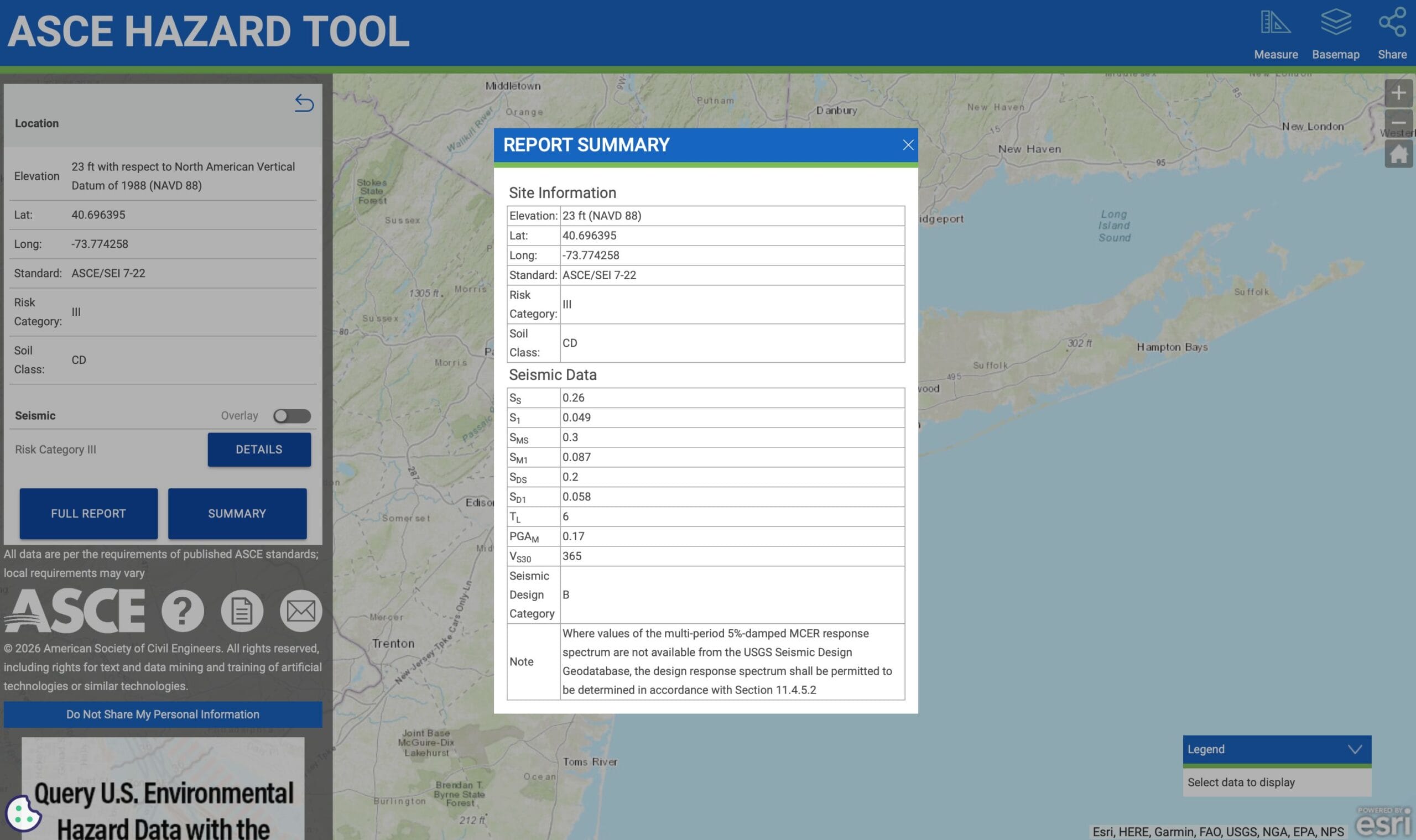
As you can notice from the screenshot, the soil classification for this location is identified as CD, which is a newly introduced soil classification. Also, there is no longer any reference to Fa or Fv.
The following is a high-level summary of the major changes. This list is intentionally kept short for convenience; however, we encourage you to use it as a starting point to review the changes in more detail:
- A multi-period response spectrum has been introduced. This topic is likely beyond the scope of the Structural Civil PE Exam and the California Seismic Principles Exam; however, a general understanding of the concept is still useful.
- The traditional response spectrum has been renamed the “two-period response spectrum.”
- The use of site coefficients Fa and Fv has been removed as mentioned previously. Instead, site-specific spectral accelerations are obtained from the ASCE 7 Hazard Tool.
- The vertical ground motion equations and associated procedures have been modified.
- The site classification procedure has changed. Site classification now relies primarily on shear wave velocity. Previously, Chapter 20 included several other parameters, such as SPT values and blow counts, for determining site class. These parameters are no longer used in the same way.
- The procedure for evaluating certain categories of horizontal and vertical structural irregularities has changed. Some factors for the remaining categories have also been modified.
- The seismic directions of loading requirements have changed. The new provisions provide a clearer distinction between independent and orthogonal combination procedures.
- New building structural systems or types have been added.
- The provisions for nonstructural components have experienced significant changes. These include modifications to the load calculation procedure, the addition of new load cases, and changes to the coefficients for architectural components and the associated R-factor table.
- Some changes have also been introduced for nonbuilding structures; however, these changes are not as extensive as the changes related to nonstructural components.
When considering all these changes together, the seismic chapters require significant attention due to the combined impact of all these updates.
Wind Load
The general wind load chapter (Chapter 26), which provides the main coefficients, equations, and tables, has not experienced major changes. The overall calculation procedure and chapter organization remain similar. However, several simplifications have been introduced in the way wind loads are handled, as discussed below.
The directional procedure in Chapter 27 previously consisted of two parts, and the envelope procedure in Chapter 28 also consisted of two parts, making a total of four different methods. The second part of each chapter provided a simplified method for certain low-rise buildings with a simplified diaphragm.
Having four different methods, together with the concept of a simplified diaphragm, caused confusion among engineers and students. We frequently received questions about what exactly qualifies as a simplified diaphragm, with many assuming that most diaphragms could be considered simplified.
“One of the major simplifications in ASCE 7-22 is the removal of the simplified methods (Part II) from both the Directional Procedure and the Envelope Procedure.”
This change requires your attention because several steps that existed in the simplified procedures are no longer used. For example, the Adjustment Factor for Building Height and Exposure, λ, has been eliminated. In ASCE 7-16, you first determined the simplified design wind pressure, pS30, for Exposure B at a building height of 30 ft. You then used Figure 28.5-1 together with Equation 28.5-1 to adjust this pressure for the required exposure category and building height as follows:
ps = λ Kzt pS30
This adjustment procedure is no longer used or necessary in ASCE 7-22.
Another noticeable change is the procedure for determining wind pressure on overhangs. Previously, if the building met the simplified criteria, these pressures were determined using the tables provided in Part II of the Envelope Procedure of Chapter 28. In ASCE 7-22, this approach has been removed, and all buildings are directed to use the provisions in Section 30.7.
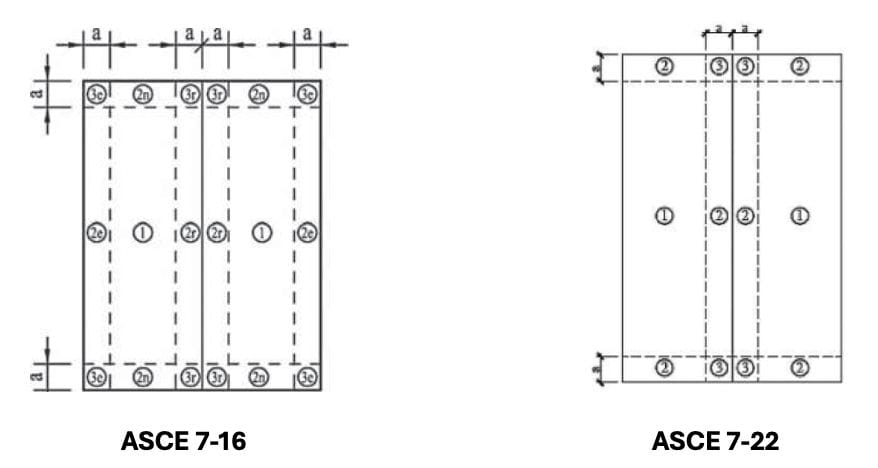
The chapter on Components and Cladding has also been simplified in several areas. The pressure coefficient zones have been simplified for many roof types. As shown in the figure comparison below for one of the roof configurations, several pressure zones have been removed, and the corner zones have been revised for many roof configurations.
We also discussed the addition of new loads at the introduction of this article. Tornado loads, which were previously addressed only in the Commentary of ASCE 7-16, are now covered in a dedicated chapter, which is Chapter 32.
Finally, you will notice some refinements to the wind maps, although the overall changes are relatively minor.
Overall, the wind load provisions in ASCE 7-22 represent a refinement and simplification of the existing procedures rather than a complete redesign, especially when compared to the much more significant changes introduced in the seismic chapters.
How To Prepare For ASCE 7-22 Changes
Although ASCE 7-22 includes many revisions, the most significant changes are the procedural changes introduced in the seismic, snow, and wind load chapters. Regardless of whether these procedural changes are simple or complex, they require engineers to familiarize themselves with the new methodology. For PE exam preparation, these procedures should be practiced beforehand rather than learned for the first time during the exam.
In addition to these procedural updates, ASCE 7-22 also introduces several other changes, including revised coefficients and factors, new load cases, new categories, and new building types. While many of these changes are relatively straightforward, candidates should still become familiar with them before the examination.
Overall, ASCE 7-22 represents an evolution and refinement rather than a complete redesign of the standard. Understanding where the major procedural changes occurred, while being aware of the smaller revisions throughout the code, will help engineers transition more confidently from ASCE 7-16 and be better prepared for both engineering practice and future PE examinations.
As the Civil PE exam continues to evolve, preparing with current, exam-focused resources becomes even more important. Petro Publications offers Civil PE study guides, realistic practice exams, and value bundles developed to reflect the latest NCEES exam specifications. We continuously monitor updates to engineering codes, standards, and reference materials, incorporating those changes into our publications well before they become effective whenever possible. This proactive approach helps ensure you are studying with the most current material available and are well prepared for exam day.
Follow us on LinkedIn and YouTube for the latest news.
Related: What Civil PE Candidates Need To Know About ACI 318-14 to ACI 318-19
