

Studying for the PE Exam takes a significant amount of time and effort. Review courses are completed, reference material is studied, practice problems are solved, and countless hours are spent preparing for exam day.
Then the result arrives:
Failed.
It is disappointing, but if you’ve failed the PE Exam, it does not mean that the entire preparation was wasted. More importantly, the second attempt does not have to begin from the same starting point as the first. There is actually a significant advantage to having already taken the exam.
A first-time candidate has never experienced the actual PE Exam. The time pressure is theoretical. The length of the exam is difficult to appreciate until it is experienced. The process of reading a question, deciding how to approach it, searching the reference material, solving the problem, and moving on to the next question is very different during the real exam than it is during normal studying.
A candidate preparing for a retake already knows what that experience is like.
The candidate has seen the style of the questions, experienced the time pressure, learned how the exam day feels, and discovered which subjects caused problems. That information is valuable.
Failing the PE exam on your first attempt should not be viewed only as a disadvantage. It provides experience that a first-time candidate does not have.
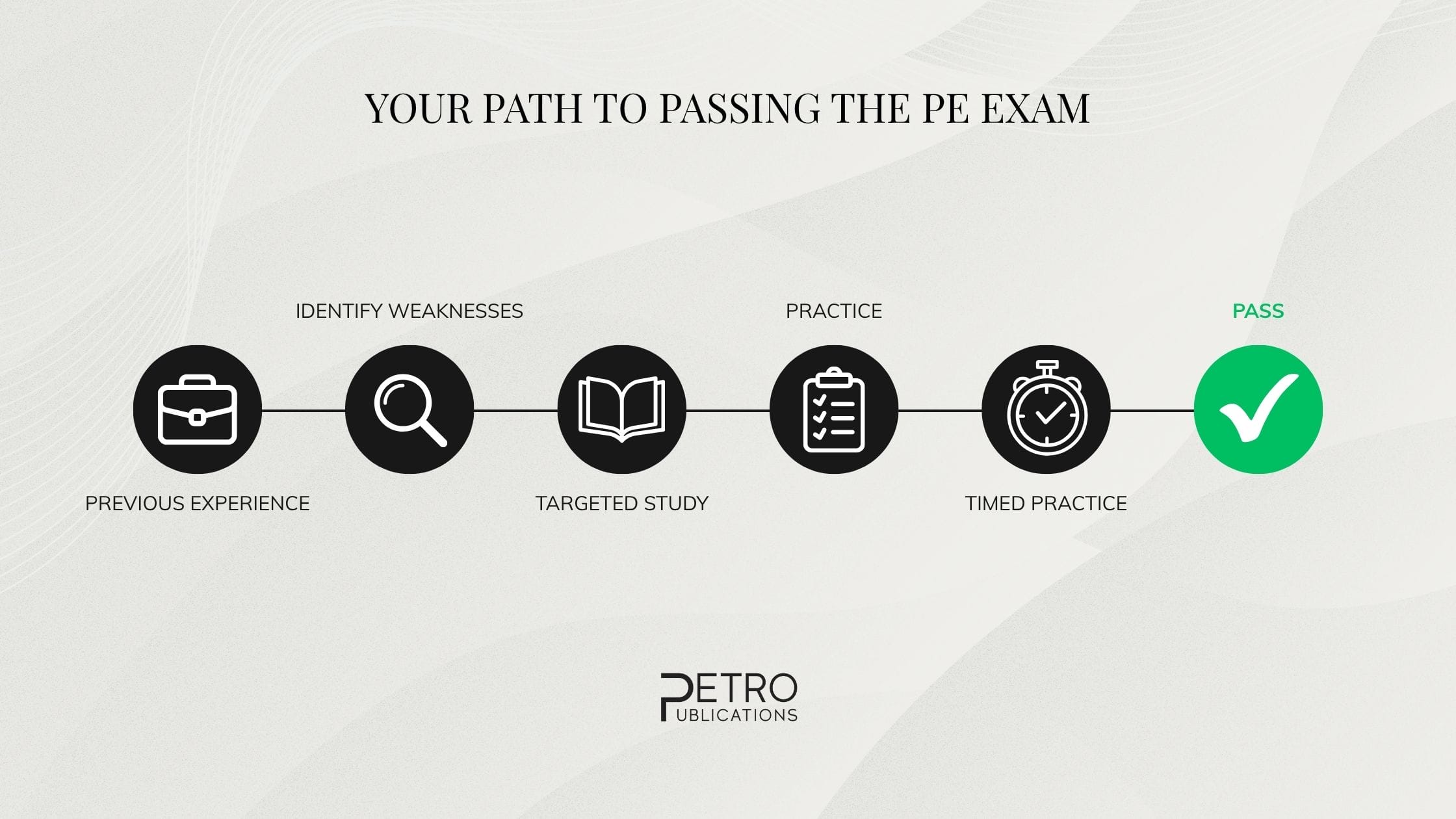
Don’t Start Everything Again After You’ve Failed The PE Exam
One of the most common reactions after you’ve failed the PE Exam is to start the entire review process again. The reasoning seems simple: if the exam was not passed, then more studying must be necessary. But more studying is not necessarily the answer.
A PE exam taker may have performed well in most areas and struggled in only a few. Another PE exam taker may have understood the technical material but had difficulty applying it to unfamiliar questions. Someone else may have known the material but simply worked too slowly.
These situations require very different solutions.
Starting a complete review course from the beginning may result in hundreds of hours being spent reviewing subjects that were already strong.
The first step after receiving a failing result should therefore be an honest assessment of what happened during the exam.
What subjects caused the most difficulty?
Which questions seemed unfamiliar?
Where was too much time spent?
Were there problems that could not be solved because the concept was not understood, or because the correct information could not be found quickly?
Was the issue technical knowledge, problem-solving ability, or speed?
Was the exam tricky with questions that were answered correctly but went unnoticed?
These questions are much more useful than simply deciding that more studying is needed.
Identify the Weak Knowledge Areas
The NCEES diagnostic report is an important starting point. It provides information about performance in the different areas of the exam and can help identify subjects that need additional attention.
However, the diagnostic report is only part of the picture.
The experience during the actual exam can provide information that a diagnostic report cannot fully capture. A subject may appear to be acceptable based on the overall result, but perhaps the questions in that area took too long. Another subject may have produced several incorrect answers because of a specific misunderstanding.
The goal is to identify the actual source of the problem. For example, if a structural engineering candidate was comfortable with most of the material but struggled with wind load design, there is little reason to spend the same amount of time reviewing hydraulics, surveying, or other subjects that were already well understood.
The retake study plan should reflect the results of the first attempt.
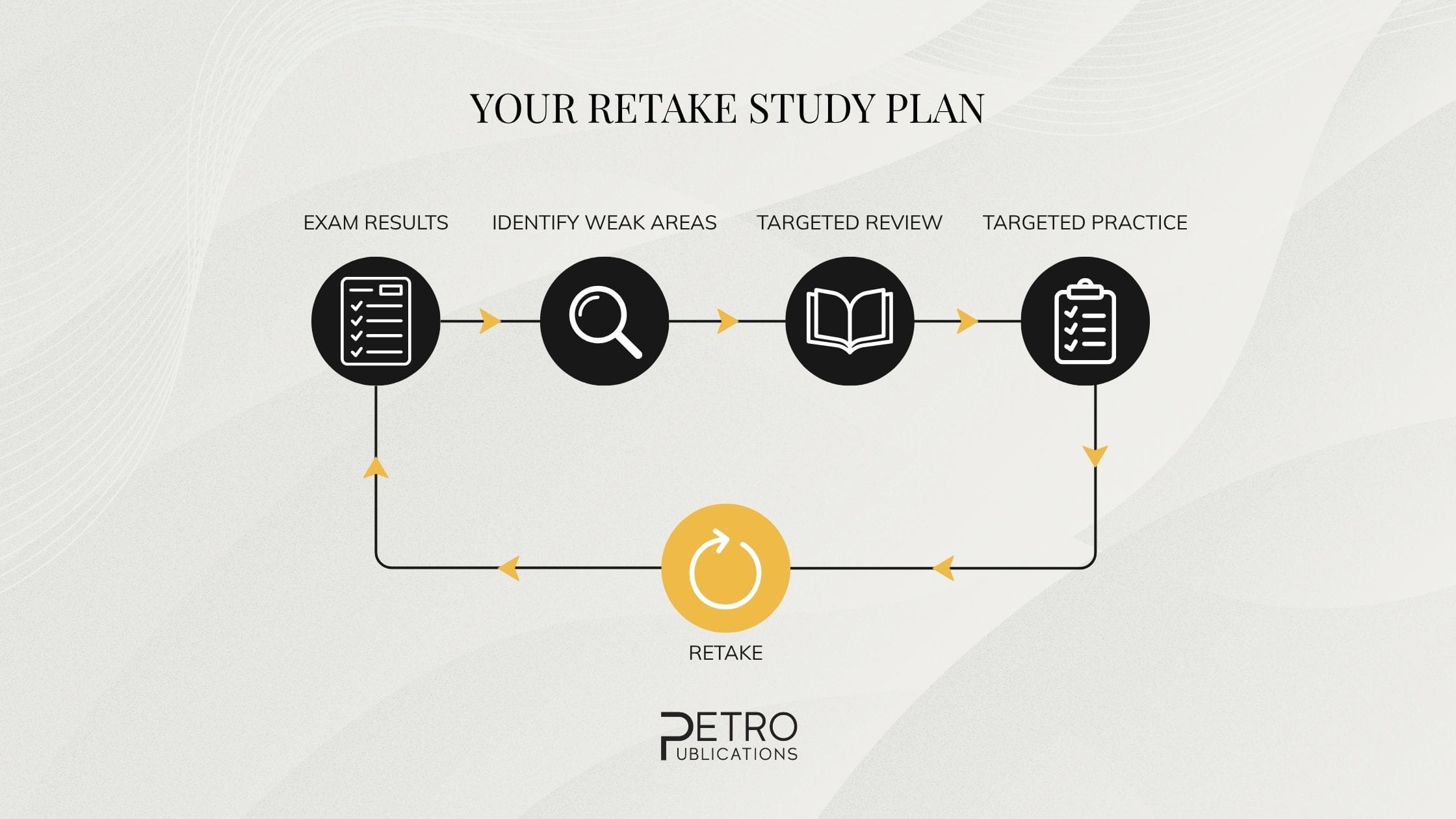
Not Every Weakness Requires the Same Solution
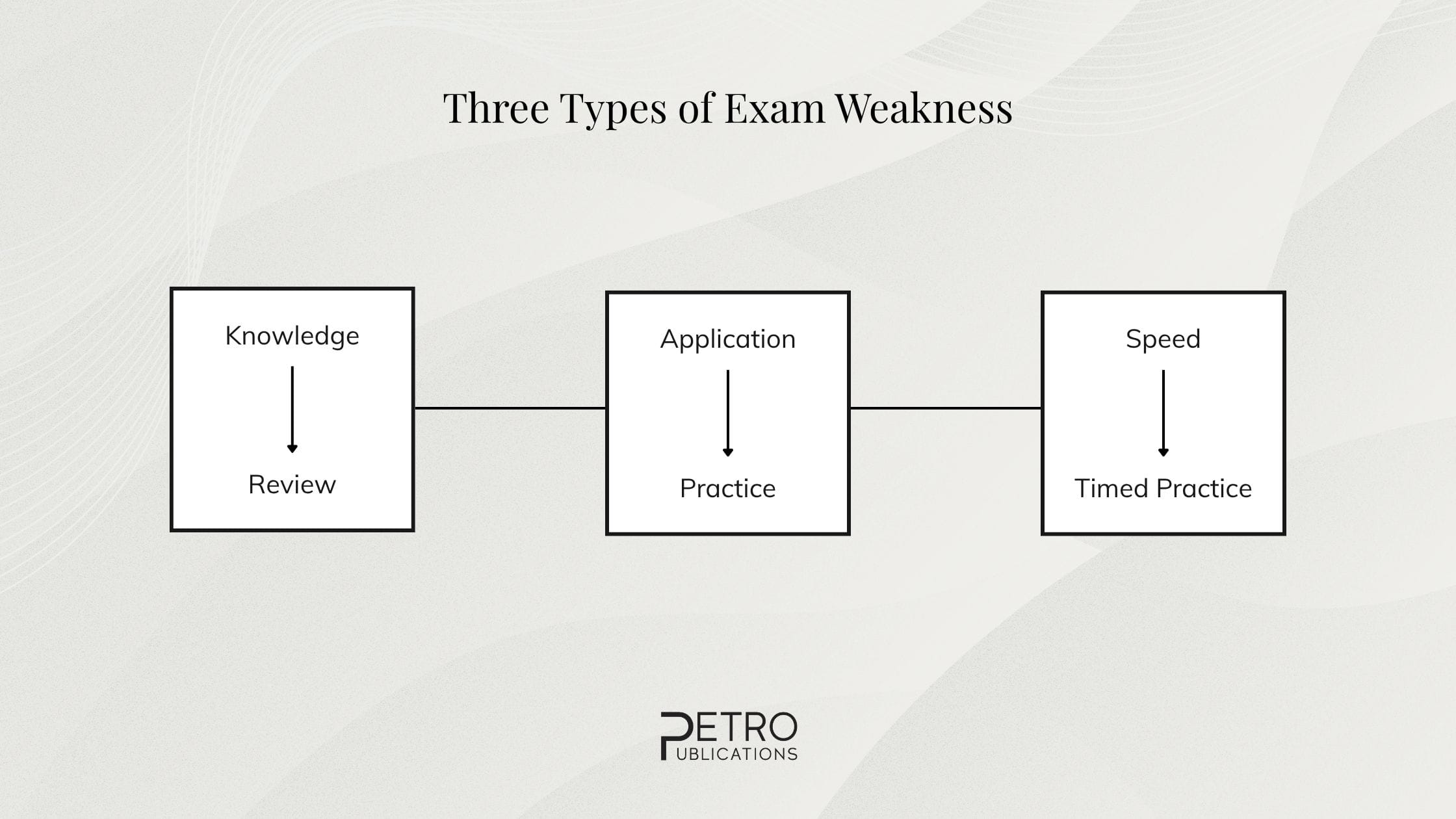
A weak result in a subject does not always mean that the underlying technical knowledge is missing. There is an important difference between not knowing a concept, knowing the concept but not being able to apply it, and knowing how to solve a problem but taking too long to do so.

A candidate who does not understand a topic needs technical review.

Or a candidate who understands the topic but struggles with application, needing more practice problems.

A candidate who can solve the problem but takes too long needs timed practice.
For this reason, the question should not simply be, “Which subjects were weak?”
A better question is:
“Why were those subjects weak?”
Finding the answer makes the study plan much more effective.
Preserve the Strong Areas
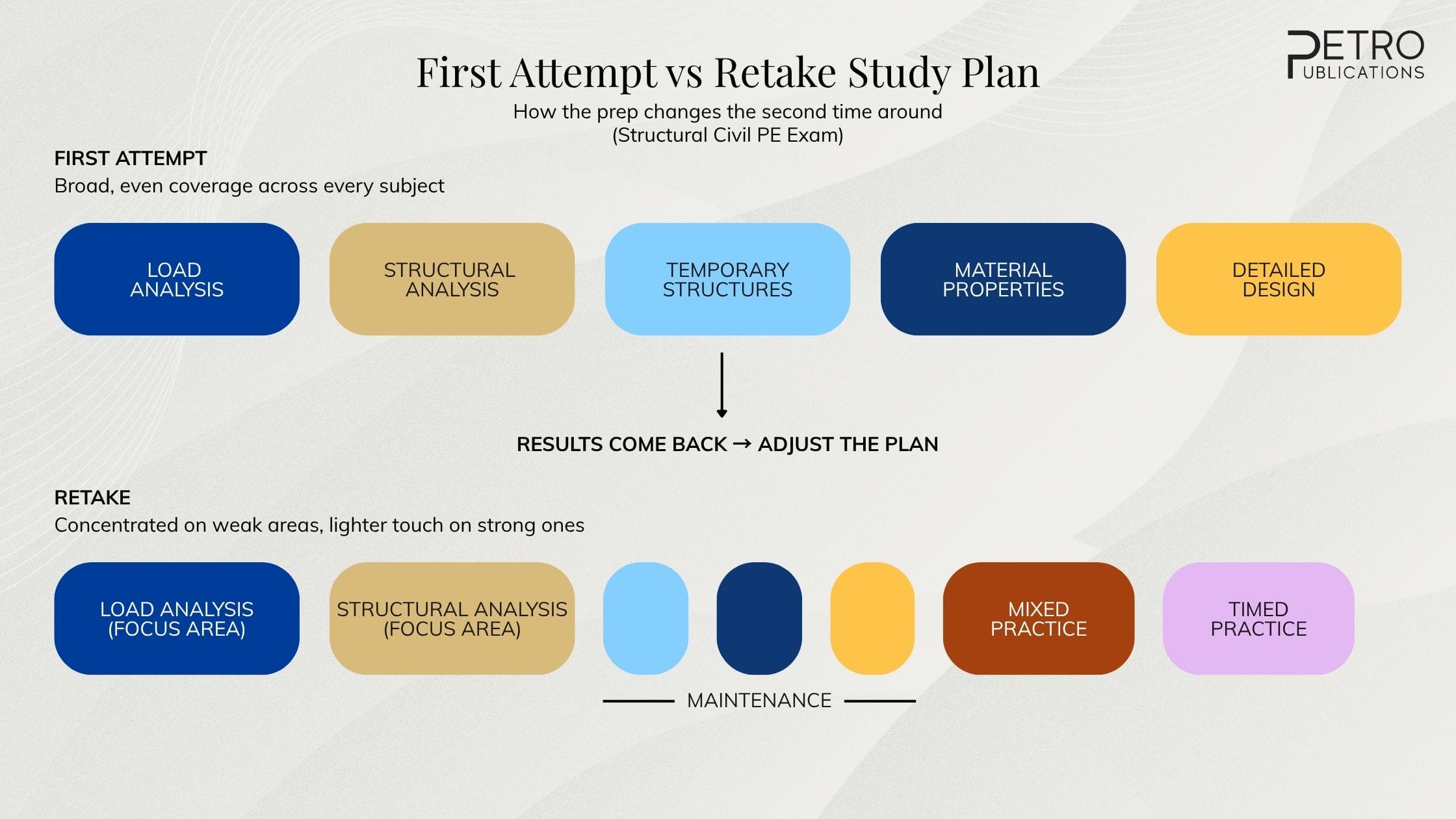
Weak areas naturally receive most of the attention during a retake, but strong areas should not be abandoned. A subject that was strong during the first attempt can become weaker after several months without practice. At the same time, spending hours reviewing material that is already well understood is usually not the best use of limited preparation time.
Occasional practice questions, short reviews, and mixed problem sets can keep strong subjects fresh without taking time away from the areas that need more attention. The objective is not to make every subject equally strong. The objective is to raise the weaker areas while keeping the stronger areas at a good level.
Rebuild the Study Schedule
A retake deserves a different study schedule from the original preparation. The first preparation often requires broad coverage. Most candidates are learning the exam material, becoming familiar with the reference handbook, and developing the basic skills needed to solve PE-style problems.
The second preparation can be much more focused. If the first attempt revealed two or three significant weaknesses, those areas should receive a larger portion of the available study time. Stronger subjects can be maintained through shorter review sessions and mixed practice.
The schedule should also change as the exam approaches. Early preparation can focus more heavily on rebuilding knowledge and addressing weak subjects. Later preparation should gradually shift toward mixed practice, timed problems, and longer practice sessions.
This approach avoids spending the entire retake period repeating material that is already familiar.
Use Targeted Practice Questions
Practice questions are particularly important after a failed attempt, but simply solving more questions is not enough. A large question bank can create the impression of progress because the number of completed questions continues to increase. However, 500 questions that repeat the same concepts may provide less benefit than 250 well-selected questions covering a broad range of concepts and difficulties.
The purpose of practice during a retake is to correct weaknesses.
Here are some solutions:
- A particular subject caused problems on the first exam. Practice questions from that subject can help determine whether the problem has actually been corrected.
- If conceptual questions were difficult, more conceptual practice is needed.
- Multi-step problems caused trouble. Those types of problems should receive more attention.
The review of incorrect answers is just as important as the questions themselves.
A missed question could be the result of a knowledge gap, an incorrect equation, a calculation mistake, a unit conversion error, a misunderstanding of the question, or simply poor time management.
Each type of mistake points to a different solution.
Don’t Just Repeat the Same Questions
Another common problem during retaking the PE Exam is solving large numbers of questions that are too similar to one another. Repetition has some value. It helps develop familiarity with common procedures and can improve speed. But after a certain point, another nearly identical problem adds very little. The real exam will not necessarily present a familiar concept in the same format as a practice problem.
Good practice should include different ways of testing the same concept. It should include calculation problems, conceptual questions, multi-step problems, and questions that require careful reading. There should also be questions that feel unfamiliar.
A practice problem that causes a candidate to stop and think, “I have not seen this before,” can be more valuable than another problem that follows a procedure already practiced twenty times.
The purpose of a question bank is not to reach an impressive number of completed questions. The purpose is to become better prepared for the questions that may appear on exam day.
Practice Under Time Pressure
The experience of the first exam should also be used to improve timing. Many candidates discover during their first attempt that knowing how to solve a problem and solving it quickly enough are two different things.
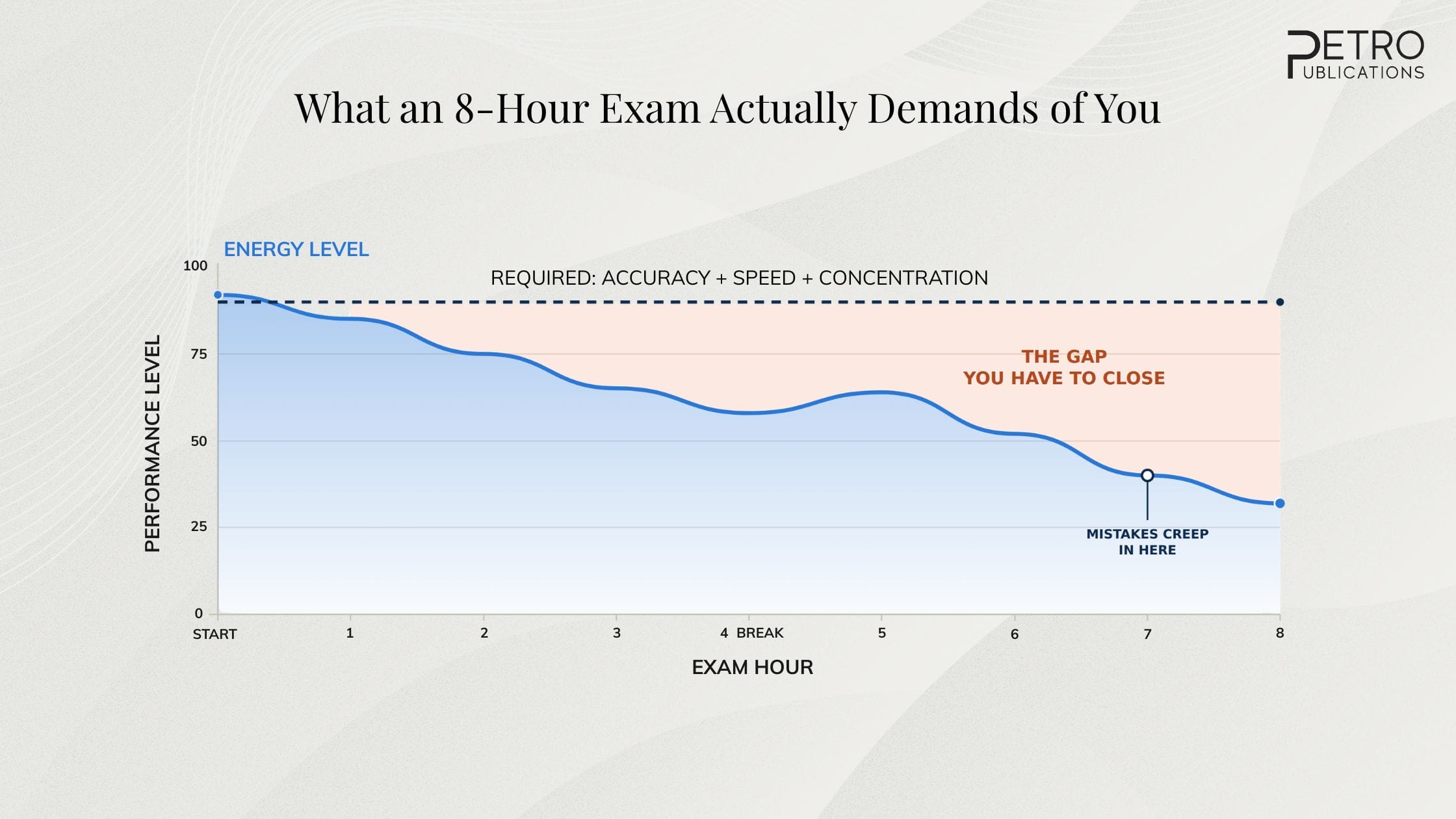
A difficult question can consume several minutes without producing an answer. A candidate may then rush through easier questions later in the exam. By the final portion of the exam, fatigue can make even relatively simple problems more difficult. That experience should become part of the retake preparation.
Practice should not always consist of solving a few questions with no time limit. Timed groups of questions should be included regularly, and longer practice sessions should become more common as the exam approaches. This develops more than speed. It develops the ability to maintain concentration and make decisions when the exam has already been going on for several hours.
The first attempt has already provided a lesson about time pressure. The second attempt is an opportunity to prepare for it.
A Candidate Who Failed May Actually Have an Advantage
A candidate preparing for a retake has already learned lessons that cannot be fully learned from a review book. You now know what the questions look like, you also know how the reference material works under exam conditions, and you certainly know how quickly time passes.
The first attempt therefore does not have to be viewed as wasted time. It can be viewed as the first stage of the preparation process.
How to Pass the PE Exam After Failing
For anyone searching for how to pass the PE Exam after failing, there is no single number of study hours, practice questions, or weeks of preparation that guarantees success. The more useful approach is to understand what happened during the first attempt and build the next preparation around that information.
Technical weaknesses require technical review. Problems with application require targeted practice. Timing problems require timed practice. Strong areas require maintenance rather than complete re-study.
The process should be focused on correcting the specific problems that prevented a passing result, and the appropriate amount of preparation depends on what the first attempt revealed.
Ready to Practice?
Once the weak areas have been identified, targeted practice is one of the best ways to address them. Practice exams can provide an opportunity to work through a wide range of PE-style problems while also developing speed, accuracy, and endurance.
Petro Publications offers Civil PE Exam study guides that are always up to date, along with realistic online practice exams. You can get them individually or in study bundles. Check out our practice exams that can help you prepare to confidently retake your PE exam.
