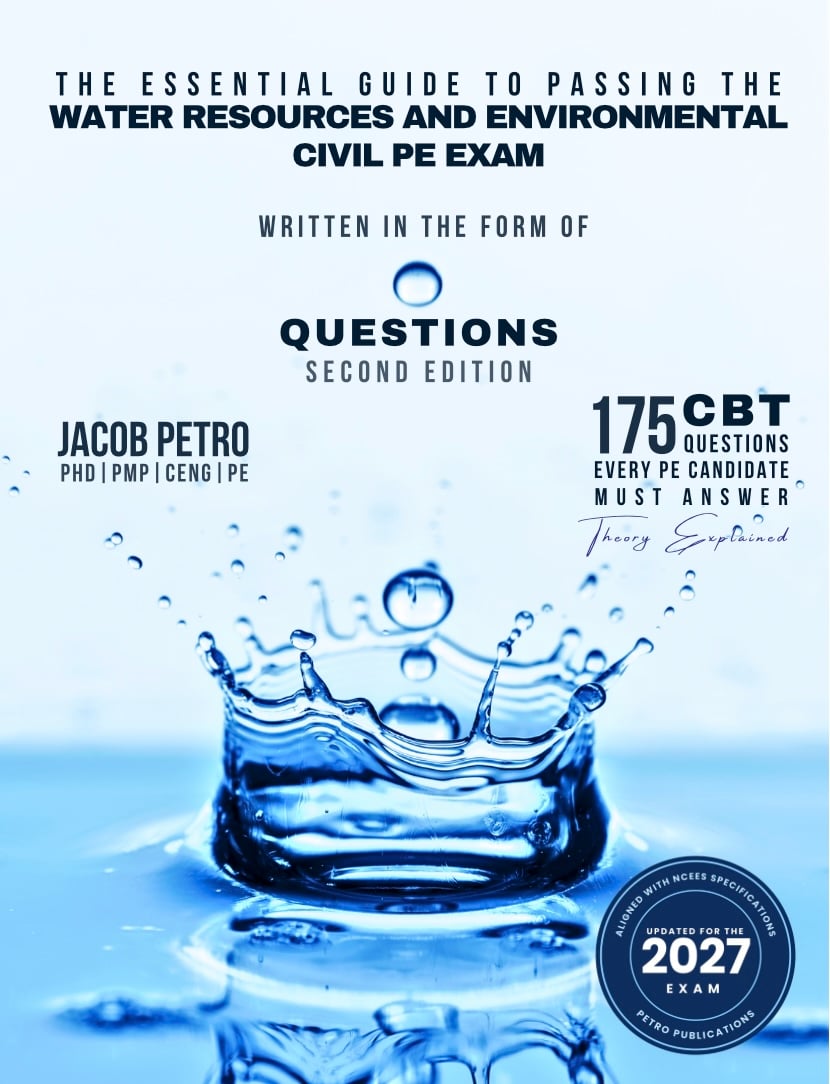
The NCEES 2027 change added five more references to the exam. We updated our questions accordingly and added more questions to bridge the gap, and we added a new section that explains and summarizes some of the important information from the new references.
Unlike short, straightforward questions, a substantial portion of the questions in this guide are designed to be slightly longer and more comprehensive, to build understanding across all aspects of water resources and environmental engineering and help candidates pass the PE Exam. The book places particular emphasis on up-to-date water resources and environmental manuals, codes and design standards, aiming to make this guide the go-to resource for exam takers.
Each question is accompanied by detailed figures that serve as visual aids, along with step-by-step solutions with proper, detailed references. Alternative solutions are also offered where possible.
Lastly, this book aims to replace expensive courses and resources that can cost hundreds or even thousands of dollars. It offers a simple yet highly effective method of learning at a fraction of the cost.
Exam standards covered:
- Hydraulic Design of Highway Culverts, Hydraulic Design Series No. 5 (HDS-5), 3rd Edition, 2012
- Hydraulic Design of Energy Dissipators for Culverts and Channels, HEC-14, 3rd Edition, 2006
- UFC 3-220-05, Dewatering and Groundwater Control, 2004
- EM 1110-2-1902, Slope Stability, 2003
- 29 CFR Part 1926, Safety and Health Regulations for Construction, 2024
- Recommended Standards for Wastewater Facilities (TSS), 2014
- Recommended Standards for Water Works (TSS), 2022
- NCEES PE Civil Reference Handbook
This book features 175 comprehensive questions to help you pass the exam on your first try. Each question is educational and designed to cover a wide range of topics, with no straightforward answers.
The questions are organized by the twelve NCEES knowledge areas:
- Project Planning – Covers quantity take-off, cost estimating, project schedules and economic analysis, including present worth and life-cycle cost.
- Soil Mechanics – Covers lateral earth pressure, consolidation and compaction, bearing capacity, settlement and slope stability, with emphasis on EM 1110-2-1902.
- Materials – Covers soil classification and boring logs, soil properties, concrete, piping materials and material test methods.
- Analysis and Design – Covers mass balance, hydraulic and solids loading, and hydraulic flow measurement.
- Hydraulics – Closed Conduit – Covers the energy, continuity and momentum equations, pressure conduits (Hazen-Williams, Darcy-Weisbach), pumps and cavitation, and pipe networks.
- Hydraulics – Open Channel – Covers open-channel flow, sub- and supercritical flow, stormwater collection, culvert hydraulics and energy dissipation, with emphasis on HDS-5 and HEC-14.
- Hydrology – Covers storm characteristics, runoff analysis (rational and NRCS methods), hydrographs, rainfall intensity-duration-frequency, time of concentration, gauging stations, depletions and stormwater management.
- Groundwater and Wells – Covers aquifers, groundwater flow, and well and drawdown analysis, with dewatering based on UFC 3-220-05.
- Surface Water and Groundwater Quality – Covers stream degradation and oxygen dynamics, total maximum daily load (TMDL), and biological and chemical contaminants.
- Drinking Water Distribution and Treatment – Covers distribution, demands and storage, sedimentation, coagulation and flocculation, filtration and membranes, disinfection, softening and other treatment, with emphasis on the Recommended Standards for Water Works.
- Wastewater Collection and Treatment – Covers collection systems, preliminary through secondary treatment, nutrient removal, solids handling, disinfection and advanced treatment, with emphasis on the Recommended Standards for Wastewater Facilities.
- Project Sitework – Covers excavation and embankment, site layout, erosion and sediment control, construction safety, horizontal and vertical curves, retaining walls and construction methods, with emphasis on 29 CFR Part 1926.
All answers are detailed and well referenced, with links to the relevant design standards and codes for your benefit.
The online Water Resources and Environmental Civil Practice Exams have been developed to provide a balanced distribution of question difficulty, along with a representative mix of conceptual and calculation-based problems. They are available now with solutions based on the pre-2027 exam specifications, and in early 2027 solutions based on the 2027 specifications will be added, so both will be available.
Using both the online Practice Exams and the Essential Guide together provides a complete study strategy, reinforcing key concepts and maximizing your preparedness for the Civil: Water Resources and Environmental PE examination.