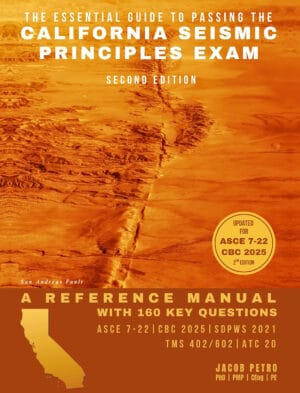
Now in its Second Edition, fully updated for the 2027 NCEES exam specifications. This guide contains 170 questions that are compliant with the latest NCEES exam specifications. It is designed to equip you with the knowledge and skills necessary to pass the Geotechnical Civil PE Exam on your first attempt.
What’s new in the Second Edition: the 2027 NCEES update added the FHWA Geosynthetic Design and Construction Guidelines and replaced the 1986 NAVFAC DM 7.02 with the new UFC 3-220-20 (2025), which is effectively a new reference. We have updated our questions accordingly and added more questions to bridge the gap.
What sets it apart is:
- Good coverage for most possible exam topics and scenarios
- A structured and guided approach to the presentation of questions
- Theory explanations for almost all the questions’ answers
- Case studies
- Alternative solutions provided with ample comments and guidance
This book aims to replace expensive courses and resources that can cost hundreds or even thousands of dollars. It offers a simple yet highly effective method of learning at a fraction of the cost.
Introduction to the Book
This book features 170 comprehensive questions to help you pass the exam on your first try. Each question is educational and designed to cover a wide range of topics, with no straightforward answers. Almost everyone who has purchased this book, studied it thoroughly and taken the exam reports that it made passing significantly easier. The questions are organized into eight parts:
- Site Characterization – Covers various surface exploration techniques, detailing the use of different apparatuses, their specifications, and applications. It also outlines methods for determining essential site characteristics, such as shear strength and rock durability, among others.
- Soil Mechanics – Covers various soil phase relationship examples, stress/strain relationships, effective and normal stress, the construction of Mohr’s circle, stress distribution and propagation, as well as permeability and relevant testing methods. This part also explains in sufficient detail the triaxial test, including the procedure and various methods of conducting this test, such as drained or undrained samples and/or consolidated or unconsolidated conditions.
- Construction Observation – Covers a wide range of topics related to construction operations and monitoring. It includes questions and case studies on lifting and rigging, deep excavations and dewatering, mass haul diagram theory, excavation calculations, and borrow pit volume, along with the various methods used to calculate it. Additionally, it addresses the concept of deep wells and the scour protection of piers.
- Earthquake Engineering – Covers various topics, including shear waves, shear wave velocity, shear modulus, and shear site characterization. It also addresses seismic design categories, liquefaction and its potential, retaining wall stability during seismic events, and slope stability. Additionally, it includes methods for earthquake-relevant site characterization.
- Earth Structures – Covers a wide range of topics on ground improvements, including interesting case studies and explanations of important conceptual topics, similar to other parts of this book. In addition to grouting techniques, slope stability methods, pavement design improvements, and the application of geosynthetics in landfills, this section now includes new questions based on the FHWA Geosynthetic Design and Construction Guidelines, and aims to encourage further research. By exploring these topics, you may discover or generate more interesting case studies that could be beneficial.
- Groundwater & Seepage – Covers a variety of topics, including dewatering, seepage in levees, groundwater flow, and its impact on nearby structures. It also discusses solutions to mitigate these impacts.
- Problematic Soil – Delves into various types of challenging soils, including, but not limited to, collapsible, expansive, sensitive, and frost-susceptible soils. It covers their identification and provides solutions for managing these soils effectively. Additionally, this section discusses some methods for site characterization in different scenarios, offering guidance for dealing with problematic soils.
- Walls & Foundations – Explores the comprehensive analysis and design of a variety of earth and critical structures. This includes an in-depth examination of retaining walls under different lateral pressure conditions, anchored walls, sheet piles, and cofferdams. For foundations, both shallow and deep types are covered extensively, whether they are single or double-shaped. The section also explores piles, providing insight into their installation methods, vertical and lateral load capacities, and various testing methods to ensure structural integrity. Additionally, this part addresses crucial topics such as stress distribution and the resulting stress shapes within these structures, with questions updated to reflect UFC 3-220-20. To enhance understanding, it includes several important and intriguing case studies, mirroring the approach taken throughout the rest of the book.
All answers are detailed and well referenced, with links to the relevant design manuals and codes for your benefit.
The online Geotechnical Civil Practice Exams have been developed to provide a balanced distribution of question difficulty, along with a representative mix of conceptual and calculation-based problems. They are available now with solutions based on the pre-2027 exam specifications, and in early 2027 solutions based on the 2027 specifications will be added, so both will be available.
Using both the online Practice Exams and the Essential Guide together provides a complete study strategy, reinforcing key concepts and maximizing your preparedness for the Geotechnical Civil PE examination.